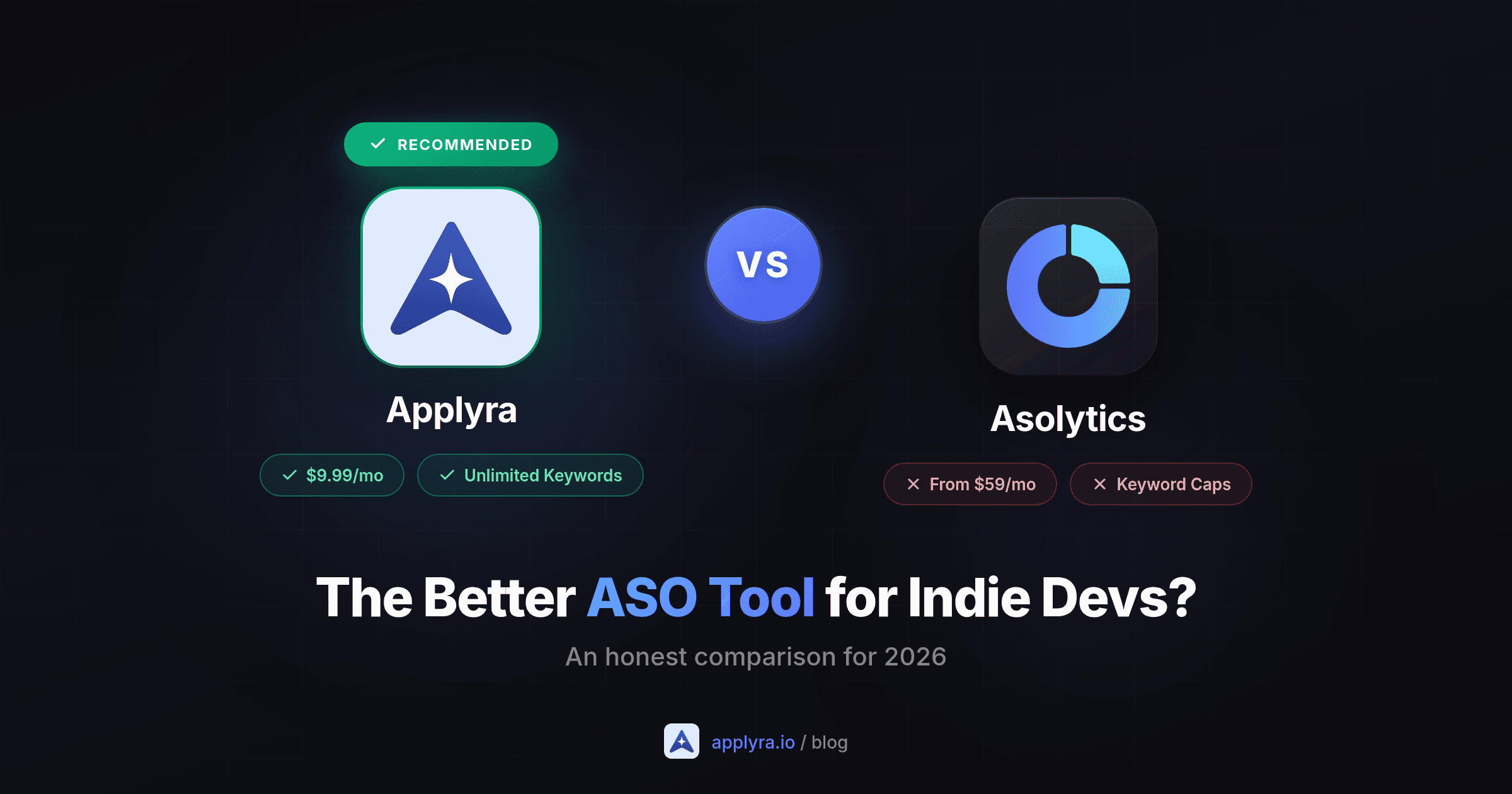
Asolytics is one of the more visible ASO platforms aimed at the mid-market. It covers both stores, tracks a lot of keywords, ships a Meta Editor, runs a Growth Helper that flags optimization mistakes, and the Ukrainian team behind it has been shipping consistently since launch.
It's a real product. This isn't a hit piece.
But if you read their pricing page as a solo developer, the structure feels off. There is no free plan any more, and the ladder opens at $49/month, then $158, then $399. Pro and Expert are built for ASO agencies and consultants managing client portfolios. Start sits awkwardly between hobbyist and professional. That's the gap an Asolytics alternative like Applyra was built for.
TL;DR
Asolytics runs three paid tiers: $49/month for 2 apps and 2,000 keywords, $158 for 6 apps and 8,000, $399 for 16 apps and 20,000. There is no free plan, only a 7-day trial. Applyra is one flat tier at $9.99/month with unlimited keywords on both stores, plus a permanent free plan. If you're indie, the math is hard to argue with.
Start tracking your keywords for free

The short answer
| Question | Answer |
|---|---|
| Cheaper of the two | Applyra, $9.99/month against $49 on annual billing |
| Free plan | Applyra. Asolytics dropped its own in 2026 |
| Keywords without a hard cap | Applyra. Asolytics caps every tier |
| Built for a solo developer | Applyra. Asolytics is aimed at agencies and consultants |
| Managing a client portfolio | Asolytics. Applyra has no agency layer |
The Quick Verdict
Asolytics is fine. The platform works, the data is detailed, the team responds to support tickets, and the Growth Helper is a real feature, not marketing copy.
The problem isn't the product. It's the pricing ladder for indie developers.
If you ship one app and track maybe 200 keywords across two countries, you don't need 2,000 keyword slots, two team seats, or 100 competitor slots per app. You need a tool that costs less than your monthly ChatGPT subscription and shows you where your rankings moved overnight.
$49
Asolytics entry plan / month
$9.99
Applyra paid plan / month
$0
Applyra free plan, permanent
Pricing, Plainly
Here are the public Asolytics tiers, taken directly from their pricing page:
| Tier | Per month (annual billing) | Apps | Keywords |
|---|---|---|---|
| Start | $49 | 2 | 2,000 |
| Pro | $158 | 6 | 8,000 |
| Expert | $399 | 16 | 20,000 |
| Enterprise | Quote | Custom | Custom |
Every plan opens with a 7-day free trial. When it ends without payment the account goes read-only: your projects and keyword lists survive, but the tool stops working. The free plan Asolytics used to run is gone, and the site moved from asolytics.com to asolytics.pro during 2026.
Applyra's structure is simpler because there's less to remember:
| Tier | Monthly | Apps | Keywords | Seats |
|---|---|---|---|---|
| Free | $0 | 1 | 5 keywords, 7 days of history | 1 |
| Unlimited | $9.99 | Unlimited reasonable use | Unlimited | 1 |
One paid tier. No annual lock-in. No "but only 2,000 keywords until you upgrade." That's it.
The practical impact: a developer tracking 600 keywords on Asolytics is paying $49/month on annual billing, the Start plan. The same workload on Applyra is $9.99/month. Over a year that's $588 versus $119.88, with roughly $470 left over for icon redesigns, paid screenshots, or just runway.
Where Asolytics And Applyra Look Similar
Let's be honest about overlap before pretending there are differences that don't exist.
Both tools cover the App Store and Google Play. Both track keyword rankings, surface keyword suggestions, run competitor analysis, and let you edit metadata in some form. Both support multiple countries. Both have a free tier. Both update ranking data multiple times a day on their paid plans.
If you put their feature pages side by side, the bullet lists are roughly the same. That's normal: ASO is a mature category and the table stakes converged years ago. Nobody is reinventing keyword tracking.
So the comparison isn't about whether a feature exists. It's about how much you pay to get to it, and what's bundled on top.
Where Applyra Diverges
One flat tier instead of a ladder
Asolytics is structured like a SaaS that wants to upsell you. Start, then Pro, then Expert, then Enterprise. Every tier has caps, and the caps push you toward the next one as you grow. That's a reasonable B2B model, but it punishes the developer who sits between "200 keywords is enough" and "I need to track 2,000," and since the free plan went away there is no longer a step below $49.
Applyra collapses the ladder. There's the free plan and there's the $9.99 plan with unlimited keywords. You upgrade once, then you stop thinking about it. No seat math, no "wait, I'm at 1,950 keywords, do I delete some or pay $140 more per month?"
Native MCP server, not just an SDK
Applyra ships a Model Context Protocol server. That means you can hook Applyra into Claude, Cursor, Claude Code, or any MCP-compatible client and ask things like "what are my worst-ranking keywords on iOS this week" or "draft a new subtitle for my US listing using my current top 10 keywords." The model has live access to your real ASO data, not a stale CSV you pasted in.
Asolytics publishes an SDK for in-app integration, the kind you embed in a mobile app to send events. That's a different product. As of this writing they don't publicly document a general-purpose REST API or MCP server for pulling your ASO data into another tool.
For an indie developer who already lives inside Claude or Cursor, MCP is the difference between ASO being a tab you open and ASO being a thing your editor knows about.
A REST API on every paid plan
Applyra also ships a versioned REST API at /api/v1 with simple X-API-Key auth and Upstash-backed rate limiting. You can pull keyword rankings into a Notion page, into a Slackbot, into a personal dashboard, into whatever you want. This isn't gated behind an Enterprise SKU.
Asolytics doesn't publicly advertise an equivalent. If you need automation, you're either exporting reports manually or hiring them to do the ASO work for you, which is a separate paid service line they run.
Built for indies, not for agencies
Asolytics targets three audiences in the same product: indie devs, ASO specialists and consultants, and product/marketing teams. They also sell paid ASO services on the side, with packages starting at $100 for keyword research and going up to $999+ for full ASO audits. That's a legitimate business model. It also means a chunk of the platform's surface area exists to support agency workflows, like multi-seat plans, client reporting, and unlimited competitors per app.
Applyra ignores that market. The whole product is built around one persona: the solo developer or small studio shipping their own apps and writing their own metadata. Every feature decision points at that user. There's a complete ASO guide for indie developers on this blog for a reason.
AI suggestions for metadata, not just an audit checklist
Asolytics' Growth Helper identifies optimization mistakes, which is useful. Applyra goes further: AI-generated suggestions for your title, subtitle, and keyword field, based on your current ranking position, your competitors, and what's working in your category. You don't just see what's wrong; you get a concrete next draft to test.
Feature Comparison
| Feature | Applyra | Asolytics |
|---|---|---|
| App Store (iOS) support | ||
| Google Play support | ||
| Permanent free plan | ||
| Free tier keyword limit | 1 app, 5 keywords | No free tier |
| Entry paid plan | $9.99/mo | $59/mo |
| Unlimited keywords on paid plan | ||
| Monthly billing without annual lock-in | ||
| Daily rank updates | ||
| Competitor tracking | ||
| AI metadata suggestions | Growth Helper audit | |
| Public REST API | ||
| Native MCP server | ||
| Bundled paid ASO services |
The last two rows cut both ways. Applyra has MCP and an API; Asolytics doesn't. Asolytics offers paid ASO services done by their team; Applyra doesn't, on purpose. If you want to outsource the work, Asolytics is a one-stop shop. If you want to do the work yourself with better tooling, Applyra is the cleaner pick.
When Asolytics Is Actually The Better Choice
I'm not going to pretend Asolytics is wrong for every reader. There are concrete cases where it's the right call:
- You run an ASO consultancy or agency with 6+ client apps and need 8,000 keyword slots and client-ready reports. The Pro plan was designed for you.
- You want done-for-you ASO work from the same vendor. Asolytics sells keyword research from $100 and full audits from $999. Applyra doesn't do services.
- You need 2,000+ keywords on a single app across many locales and you'd rather pay $49/month than think about it. Applyra's unlimited tier covers this too, but if you trust Asolytics' data layer specifically, that's a fine reason to stay.
Outside those profiles, the value proposition gets harder to defend for indie developers.
The Real Question For Indie Developers
The honest framing isn't "is Applyra better than Asolytics." It's "what does an indie developer actually need from an ASO tool, and which tool charges for that without padding the bill?"
What you actually need: track 100 to 500 keywords on iOS and Android. See your daily ranking movement. Know which keywords are worth chasing versus which ones you'll never crack. Get a useful suggestion when you sit down to rewrite your subtitle. Maybe pull the data into your own dashboard if you're that kind of person.
That's a $9.99/month problem. It's not a $59/month problem and definitely not a $199/month problem. Applyra prices accordingly. If you're curious how this compares across the wider field, the best free ASO tools for indie developers in 2026 walks through the rest of the landscape.
Bottom Line
Asolytics is a legitimate ASO platform with a real team and real data. The Pro plan is genuinely useful for agencies. The 7-day trial is enough to kick the tires.
The middle, the Start plan at $59/month, is where indie developers get squeezed: more than you need, less than agencies need, priced for the segment above you. That's the gap Applyra fills with a permanent free plan, $9.99/month for unlimited keywords, a public API, and a native MCP server.
If you're shipping your own apps and writing your own metadata, that's the side of the comparison that lines up with your situation. If you're running an agency, Asolytics Pro is fine. Pick the tool that was designed for the work you're actually doing.
For the full comparison across every tool, see the best ASO tools for indie developers.
Frequently asked questions
Is Applyra a real alternative to Asolytics?
Yes, for indie developers and small studios. Both tools track keywords on App Store and Google Play and cover competitor intelligence. The difference is positioning and entry cost: Asolytics starts at $49 per month and is aimed at ASO agencies and consultants, and it no longer has a free plan. Applyra keeps a single $9.99 per month plan with unlimited keywords, plus a permanent free plan, which fits the indie budget better.
How much does Asolytics cost?
Asolytics no longer has a free plan. Start is $49 per month on annual billing for 2 apps and 2,000 keywords, Pro is $158 for 6 apps and 8,000 keywords, and Expert is $399 for 16 apps and 20,000 keywords, with an Enterprise tier on quote. Every plan begins with a 7-day free trial, after which the account drops to read-only until you pay.
Does Asolytics cover both iOS and Android?
Yes. Asolytics tracks both the Apple App Store and Google Play across more than 80 countries. So does Applyra. On the store coverage axis, the two tools are equivalent. The differentiation shows up in pricing structure, keyword caps, and whether there is a free plan at all.
Does Asolytics have a public API or MCP server?
Asolytics publishes an SDK for in-app integration but does not publicly advertise a general-purpose REST API or an MCP server for querying ASO data programmatically. Applyra ships both a versioned REST API and a Model Context Protocol server, which lets you query keywords and rankings directly from Claude, Cursor, or any MCP client.
Why is Applyra cheaper than Asolytics?
Different audience, different cost structure. Asolytics targets indies, ASO consultants, agencies, and marketing teams in the same product, and bundles paid ASO consulting services on top. Applyra targets indie developers and small studios only, runs lean, and ships one flat $9.99/month tier with unlimited keywords. Less surface area to price, simpler pricing.
When does Asolytics make more sense than Applyra?
If you are an ASO consultant or agency managing 6 or more client apps, need 8,000 keywords tracked, or want bundled paid ASO services from the same team, the Asolytics Pro plan is built for you. For solo developers and small studios shipping 1 to 3 apps, that capacity stays unused and the bill is a stretch.
Ready to optimize your app?
Start tracking keywords and improving your app visibility on both stores - free, no credit card required.