A user opens ChatGPT, types "best offline habit tracker for iOS, no subscription, no cloud", and hits send. Ten seconds later they have three app names. They pick one. They never opened the App Store.
That pattern is not hypothetical anymore, and it breaks most of what indie developers assume about app discovery.
Traditional App Store search is a keyword and velocity game. The apps that win usually have bigger budgets, more reviews, and more installs. AI-driven discovery rewards something very different: tight intent matching and consistent positioning across the web. That is a surface where a focused indie app can quietly outrank a bloated enterprise one. This guide is how to get your app recommended by ChatGPT without an enterprise ASO budget.
What you'll learn
- How ChatGPT and AI assistants actually pick which apps to recommend
- Why sharp niche positioning beats broad feature lists for indie app visibility
- The specific signals that move AI recommendations, with week-one actions
- How to measure AI visibility without paying for an enterprise tool
What is actually happening with AI app discovery
Two things changed in the last six months, and together they opened a new discovery layer on top of the App Store and Google Play.
First, OpenAI launched the ChatGPT app directory to general availability on December 17, 2025, and opened third-party submissions to any verified developer shortly after. Pilot partners at launch included Booking.com, Canva, Coursera, Figma, Expedia, Spotify, and Zillow. Apps are built on OpenAI's Apps SDK, which is an open standard built on top of the Model Context Protocol (MCP). The directory is currently available to logged-in ChatGPT users outside the EEA, Switzerland, and the UK.
Second, ChatGPT is increasingly used as a shortcut to pick apps, even apps that are not in the directory at all. When someone asks "what's the best expense tracker for freelancers in Europe?", ChatGPT will surface named mobile apps in its answer, synthesized from training data and live web retrieval. That is the surface most indies can realistically compete on right now.
Google has been nudging in the same direction. The Play Store's "Apps" tab was redesigned in late 2025 to use Gemini for personalized collections and conversational Q&A, and the "You" tab brings together usage, subscriptions, and AI-generated recommendations. The signal is clear: discovery is shifting from "what did they type?" to "what are they actually trying to do?".
A recent AppTweak poll makes the urgency obvious. 41% of app marketers said monitoring how AI recommends their app was the top strategy they want to prioritize for AI search visibility. Awareness is catching up fast. Execution is not. That gap is where a motivated indie still has room to move.
Why indie apps have a structural edge
This part is underrated. LLMs do not retrieve the way App Store search does.
App Store search rewards keyword density and breadth. The generic note-taking app that stuffs twelve use cases into its subtitle and throws twenty keyword variants at the algorithm will rank for a long tail of terms. That strategy works on a keyword index.
LLMs do not rank keywords. They retrieve a small candidate set based on intent, and the signal they respond to is consistency of association. If your app is described the same way across your website, your App Store listing, Reddit threads, and roundup articles, the model builds a strong link between your app and that specific problem. If your positioning is all over the place, you become fuzzy, and fuzzy does not get recommended.
That dynamic quietly favors the indie app that does one thing clearly over the enterprise app that tries to be everything. A B2B note-taking app with ten verticals and four personas reads as generic to a model. "The plain-text journal for runners who hate cloud sync" reads as a specific answer to a specific prompt. The shorter the distance between the user's intent and your positioning, the likelier you are to be the recommendation.
This is also why the "10 ASO mistakes" trap of a vague title with no clear positioning hurts you twice in 2026. You lose the App Store ranking and the model has nothing distinctive to associate you with.
The signals that get your app recommended by ChatGPT
When ChatGPT produces an app recommendation, it is drawing on two kinds of input: what it learned during training, and what it pulls live from the web when answering. You can influence both, but not with the tactics you are used to.
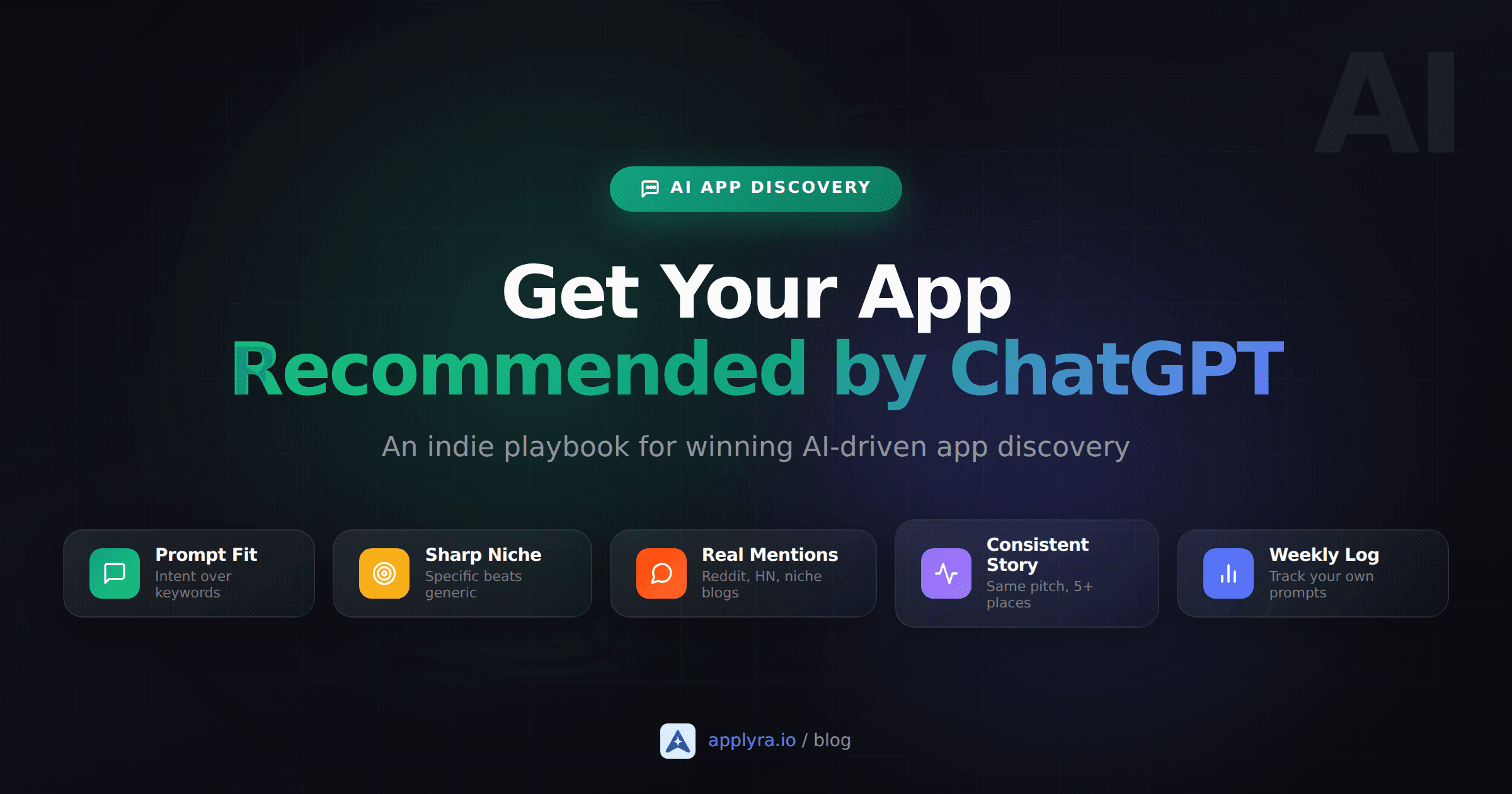
1. Repeated association across the sources a model crawls. This is the single biggest lever. A model builds a stronger link between your app and a user intent every time that pairing shows up in trusted sources. That means your website, your App Store description, your GitHub README, your Product Hunt page, your Reddit comments, and the blogs that cover you should all frame the same problem in roughly the same language. Pick one sentence that answers "what is this app for and who is it for?", and repeat it everywhere. Do not paraphrase for cleverness. Consistency is what the model is looking for.
2. Third-party mentions, especially on crawler-heavy sites. Reddit is the most visible example. It is heavily indexed and heavily cited by LLMs, and long-form threads in niche subreddits can outperform a dozen blog posts. A genuine recommendation from a real user in r/androidapps or r/iOSProgramming is worth more than any self-published SEO piece. Hacker News, niche Discord discussions that leak to the indexed web, and roundup articles on smaller blogs all feed the same machine.
3. App Store performance still matters, indirectly. Strong rankings correlate with more reviews, more press mentions, and more editorial coverage, all of which feed back into the training signal. AI visibility is not a replacement for ASO fundamentals like clear metadata and solid conversion. Think of it as a second track running on the same engine. If you need the basics, start with the ASO fundamentals guide.
4. Structured on-page content that is easy to retrieve. This is where you'll hear a lot of noise about llms.txt, the markdown file some have proposed as a "treasure map for AI". Be skeptical. Analyses of hundreds of thousands of domains in early 2026 have found no confirmed impact on ChatGPT citations, and Google has publicly said its AI Overviews still rely on traditional SEO signals. What does seem to help is boring and proven: clear H1s, a plain-language FAQ on your website, real answers to the questions your users actually ask, and schema markup where it applies. Write for a human who reads fast. That is also how a model prefers to read.
The compound signal
You do not need to win every signal. You need the same message to show up in enough places that the model cannot mistake you for something else. One clear positioning sentence, repeated across 5 to 8 sources a model can reach, beats a dozen clever variations nobody can connect.
A week-one checklist for indie app visibility in ChatGPT
Treat this as a sprint you can run in one focused week. None of it requires a paid tool.
Day 1: Write your positioning sentence. One sentence. It must name the user, the problem, and one concrete differentiator. Not "the best habit tracker". Write "a private, offline habit tracker for runners who don't want a subscription". Specificity is the whole point.
Day 2: Propagate it. Paste that sentence, or a tight variant of it, into every place you control: your website hero, your App Store subtitle and first description line, your Google Play short description, your GitHub README, your Product Hunt tagline, your X or Mastodon bio. If your metadata needs a rewrite, this is also a good moment to fix the classic iOS keyword field mistakes.
Day 3: Plant yourself on Reddit, honestly. Find two or three niche subreddits where your target user hangs out. Do not post a promo. Answer three real questions helpfully, and mention your app only when it is genuinely the right answer. This is slow but it compounds. Reddit content sticks in LLM retrieval for a long time.
Day 4: Add an FAQ section to your landing page. Include the questions a user would actually ask ChatGPT: "is it offline?", "does it sync?", "is it free?", "how does it compare to X?". Answer in the same language your positioning sentence uses. Schema markup on that FAQ does not hurt.
Day 5: Audit third-party coverage. Google your app plus your niche. If nobody has written a roundup that includes you, consider pitching a guest post or reaching out to small blogs that cover your vertical. One well-placed mention on a site that ranks is worth more than ten on sites nobody cites.
Day 6: Set up a weekly prompt log. Pick 8 to 12 prompts a real user would type. "Best offline habit tracker iOS no subscription". "Privacy-first mood journal for Android". Run them in ChatGPT, Claude, and Gemini once a week. Note if your app appears, where, and how it is described. This is your free AI visibility tracker.
Day 7: Keep tracking the App Store side too. AI discovery and traditional ASO reinforce each other. Good rankings drive reviews and coverage, which feed the model. You still need to know your keyword positions. Track your keywords for free with Applyra and watch both surfaces instead of trading one for the other.
Measuring AI visibility without an enterprise tool
On April 7, 2026, AppTweak shipped AI Visibility for Apps, the first commercial tool positioned specifically to track app recommendations inside ChatGPT. It is a useful signal that this is now an official category, but it is also priced for teams, not solo devs.
For an indie budget, manual tracking works surprisingly well. Keep a spreadsheet with three columns: the prompt, the date, and the apps ChatGPT named. Run 10 prompts weekly. Include at least two per prompt cluster: one broad ("best habit tracker"), one specific ("best offline habit tracker ios no subscription"), one comparative ("habit tracker better than streaks").
Two things to watch for in your log. The first is consistency across runs. ChatGPT will give slightly different answers over time, and a one-off appearance is noise. A pattern across a month is signal. The second is variance between models. The same brand can see wildly different visibility on ChatGPT, Claude, and Gemini, sometimes by orders of magnitude. If you only track one, you are flying blind on the others.
41%
of app marketers now prioritize AI recommendation tracking
Dec 17, 2025
ChatGPT app directory opened to the public
$0
to run a weekly manual AI visibility check
Where to start this week
Pick one thing. Write the positioning sentence and put it in five places by Friday. Next week, answer three Reddit questions in your niche honestly. The week after, start the prompt log. That is the whole plan.
The apps that get recommended by ChatGPT are not necessarily the biggest. They are the ones that have repeated the same specific story in enough places that a model can confidently hand them back as an answer. Indie developers who commit to a sharp positioning and distribute it patiently have more room on this surface than they do on the App Store charts.
If you want to keep both tracks honest, pair your weekly prompt log with real keyword tracking so you can see when a move on one surface ripples through the other. That is usually where the real story is.
Frequently asked questions
How does ChatGPT decide which apps to recommend?
ChatGPT relies on two inputs: what the model learned during training (which is influenced by how frequently and consistently your app is associated with a specific use case across public sources) and live web retrieval at query time. Apps that show up in roundups, Reddit threads, and documentation with consistent positioning are more likely to be recommended than apps with scattered or vague descriptions.
Is AI app discovery replacing traditional ASO?
Not replacing, stacking. Users still search the App Store and Google Play directly, and those rankings feed the reviews and mentions that in turn influence AI recommendations. Treat AI visibility as a second channel that shares fundamentals with ASO rather than a replacement for it.
Do I need an llms.txt file for LLM visibility?
Probably not. Analyses of large domain samples in early 2026 have not shown a measurable effect on citations, and Google has stated that AI Overviews rely on standard SEO signals. Prioritize a clean site with a real FAQ, schema markup where it applies, and consistent positioning across your owned and earned channels.
How long does it take to see results from an AI visibility effort?
Longer than ASO. Traditional App Store changes can show within days. AI recommendations shift as retrieval sources update and, to a slower degree, as training data refreshes. Plan for 4 to 8 weeks before a new positioning statement and a consistent distribution effort show up in how ChatGPT answers a typical prompt.
Can a free indie app realistically rank in ChatGPT recommendations?
Yes, often more easily than a generic paid competitor. LLM retrieval rewards specificity. An indie app with a narrow, well-articulated niche and a few solid Reddit threads can outperform a bigger app with a vague positioning, because the model can more confidently map it to a user intent.
Ready to optimize your app?
Start tracking keywords and improving your app visibility on both stores - free, no credit card required.