Most app store optimization advice is vibes. "Target long-tail keywords." "Some categories are competitive." Sure, but how much? By how many points? Where exactly does the winnable stuff live?
So we pulled the numbers. This is a look at 800,000 keyword-and-market combinations scored by Applyra across the App Store and Google Play, each one carrying a keyword difficulty score and a search traffic score computed from live store signals. No survey, no opinions, and no benchmarks borrowed from someone else's report. Just what our own measurements say about ranking an app in 2026, and what they mean if you are an indie developer without an enterprise budget.
That distinction matters more than it sounds. Most published ASO statistics are compiled: they average figures from a handful of third-party reports, which is why the same numbers circulate for years after the stores that produced them changed. Every figure below is measured directly, on keywords that were scored this month.
How to read this
Every keyword in our database gets a difficulty score (0 to 100, how hard it is to break into the top ranks) and a traffic score (0 to 100, how much it is searched), both built from live store signals. Higher difficulty means stronger apps already hold the top spots. The figures below are medians across the full set, split by store, measured in September 2026.
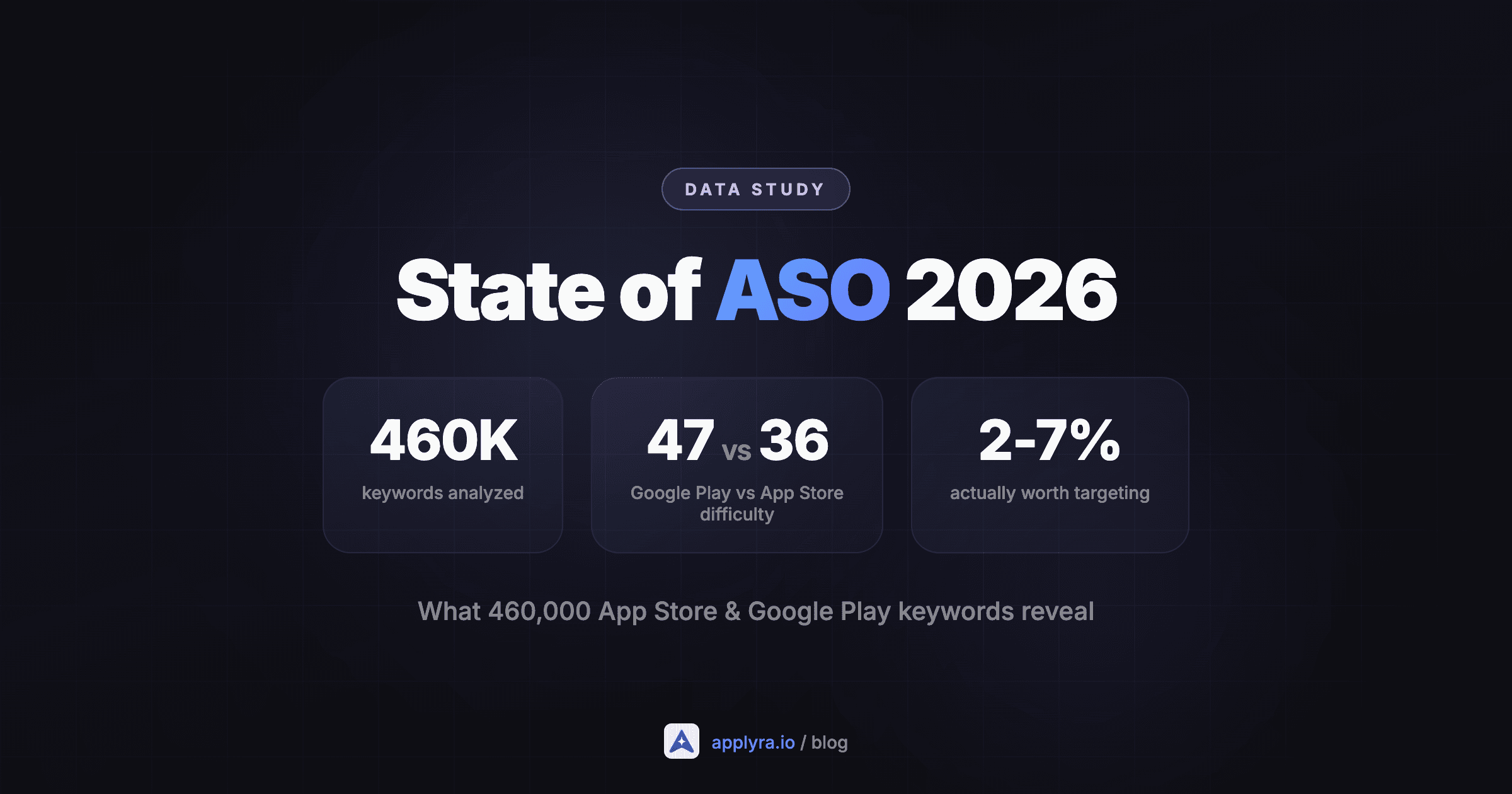
800K
keyword-market pairs analyzed
37 → 20
median difficulty, one word to three
20% → 4%
keywords worth targeting, head to tail
The long-tail advantage, measured
Everyone says target long-tail keywords. Almost nobody tells you the actual pay-off. Here it is, by keyword length, with each store measured on its own.
| Keyword length | Difficulty (iOS) | Traffic (iOS) | Difficulty (Google Play) | Traffic (Google Play) |
|---|---|---|---|---|
| 1 word | 37 | 50 | 37 | 54 |
| 2 words | 25 | 10 | 25 | 14 |
| 3 words | 19 | 8 | 23 | 8 |
The pattern is real and it is big. Adding one word to a single-word term drops median difficulty by 12 points on both stores. Add a third and the App Store keeps falling to 19.
Something worth pausing on: those two difficulty columns were measured independently, on different stores, with different signals, and they land on the same numbers for one and two-word keywords. We did not tune them to agree. When two separate measurements of the same phenomenon converge, the phenomenon is usually real.
Now look at the traffic columns, because this is the part the vibes-based advice skips. Traffic does not fall in step with difficulty. It falls off a cliff. On the App Store, going from one word to three cuts difficulty by 49 percent and cuts traffic by 84 percent.
Where the winnable keywords actually live
Here is the number that should change how you do keyword research, and it is not the one we expected to find.
A keyword is only worth your time if it is both winnable and searched. Winnable but nobody searches it is vanity. High traffic but impossible to rank is a waste. So we counted keywords that clear both bars at once: difficulty under 40 and a traffic score of 30 or higher.
| Keyword length | Winnable and searched (iOS) | Winnable and searched (Google Play) |
|---|---|---|
| 1 word | 19.5% | 22.4% |
| 2 words | 8.0% | 15.0% |
| 3 words | 2.5% | 3.8% |
| 4+ words | 4.0% | 2.3% |
Read that column again. The share of genuinely useful keywords is highest on single words and collapses as phrases get longer. One in five single-word keywords is both reachable and searched. By three words, it is one in forty on the App Store.
This is the opposite of how long-tail advice is usually framed, and the mechanism is in the previous table: long-tail keywords get easier more slowly than they get quieter. You are not trading a hard keyword for an easy one. You are trading a hard keyword for an easy keyword that fewer people type.
The honest version of 'go long-tail'
Long-tail still works, but not as a blanket rule. The tail is where the easy keywords are, not where the opportunities are densest. The move is not "make keywords as long as possible", it is "find the two-word phrases that still carry traffic", because that band holds both a real difficulty discount and a real audience. Going to four words mostly buys you silence.
One caveat we owe you: that 30-point traffic bar is our line, not a law of nature. Draw it lower and more long-tail keywords qualify. The shape of the curve does not change, though, because traffic keeps falling faster than difficulty at every threshold we tested.
Why we do not rank the two stores against each other
An earlier version of this study compared absolute difficulty between the App Store and Google Play and concluded one was markedly harder. We have removed that comparison, and the reason is worth explaining, because you will see the same claim elsewhere.
Difficulty is a model score, not a number Apple or Google publishes. Ours is built from the public signals each store exposes about the apps already ranking. Those signals are not the same on both sides: Google Play exposes a written-review count per storefront, while the App Store exposes a rating count. They measure different things, at different scales, and no honest normalization makes one directly convertible into the other.
So a cross-store difficulty gap mostly tells you how the tool was built. Any ASO tool that hands you a single difficulty number for both stores is making the same silent choice, whether or not it says so.
What does compare
The shape inside each store compares cleanly, because it is the same measurement applied to itself: how difficulty moves with keyword length, which categories run hotter, how much of the set is worth targeting. That is where every figure in this article now lives, and it is why the two stores can be read side by side above without ranking one against the other.
Which categories are hardest
Difficulty lives at the keyword level, not the category level, but some categories are structurally more crowded. Here is average keyword difficulty by App Store category, limited to categories with a large enough sample to trust.
| Category (App Store) | Avg keyword difficulty |
|---|---|
| Games | 44 |
| Utilities | 37 |
| Reference | 35 |
| Health & Fitness | 34 |
| Productivity | 33 |
| Finance | 31 |
| Lifestyle | 30 |
| Photo & Video | 29 |
| Education | 28 |
Games is the meat grinder, and by a wide margin: 16 points above Education. That tracks, because it is an enormous, mature category where well-funded studios have optimized for years. Education, Photo & Video and Lifestyle are, on average, more forgiving.
Do not over-read this. A category average hides a lot, and there are winnable keywords in Games and brutal ones in Education. We went deeper on why the Games number is what it is, and what to do about it, in mobile game ASO. But if you are pre-launch and choosing how to position a flexible app, the easier neighborhoods are worth knowing.
What this means if you are an indie developer
Four takeaways, straight from the data:
- Do not treat long-tail as a strategy on its own. It is a tactic with a cost. Every word you add buys difficulty and sells traffic, and past two words the trade turns bad fast.
- Live in the two-word band. It carries a 12-point difficulty discount over single words while keeping real search volume. On Google Play, 15 percent of two-word phrases are both winnable and searched, nearly double the App Store rate at that length.
- Filter on two numbers, never one. Most keywords fail on difficulty or on traffic, and which one they fail on is invisible until you score both. This is also why "give me keywords for my app" is the wrong prompt to hand an AI agent: anchor the request in these two numbers and it stops handing you head terms.
- Weigh the category, not just the keyword. If your app could plausibly sit in more than one category, a 16-point spread between Games and Education is real.
None of this needs an enterprise tool. It needs difficulty and traffic data for the keywords you are considering, which is the core of what an ASO tracker does. You can check any keyword's difficulty and traffic free, no account, with Applyra's keyword tool. I walk through the full method in the complete ASO guide for indie developers.
How these numbers are computed
Neither Apple nor Google publishes a difficulty figure. Nobody outside those two companies has one. So a difficulty score has to be built, and it is worth knowing what goes into ours before you act on any of the above.
For a given keyword, in a given country and language, we pull the apps currently ranking for it and score two things:
- Difficulty measures how hard it is to break into the top ranks. It reads the strength of the apps already there (their install base and rating volume on that specific storefront, not a worldwide total) and how many of them deliberately target the term in their own metadata. An entrenched top ten pushes it up; a top ten of apps that merely happen to match pushes it down.
- Traffic measures whether anyone is actually typing it, from the store's own demand signals rather than a web search volume borrowed from Google.
Both run on live store data and are recomputed as the rankings move, which is what makes a table like the one above possible at this scale: 800,000 keyword-market pairs, each scored on its own storefront, not a sample extrapolated to a market. The same engine runs behind Applyra's free keyword tool, so any figure in this article can be checked on a keyword you care about, without an account.
That is also the part worth stealing even if you never use our tool: score the two dimensions separately, on the storefront you actually ship to, and refuse to act on a single blended number.
One event is worth flagging if you compare these numbers to anything you measured earlier: Apple recalibrated iOS search in late July 2026, which changed who ranks and therefore moved every difficulty score in every tool. We tracked it day by day in why App Store keyword rankings dropped overnight.
These figures cover the keywords indie developers and small studios actually track, not a census of every term in existence. Treat the exact decimals as directional and the patterns as solid, because they hold across hundreds of thousands of keywords and, for the length curve, replicate independently on both stores.
The bottom line
App store optimization in 2026 is not a mystery, but it is a filtering problem. Most keywords are too hard or too quiet to matter, and which failure applies flips as phrases get longer: head terms fail on difficulty, tail terms fail on traffic. The band that clears both bars is narrower than the advice suggests, and it is not where you were told to look.
The developers who win are not the ones targeting the most keywords. They are the ones who checked both numbers before writing a single line of metadata.
Doing that by hand does not scale past a dozen keywords, which is the entire reason a tool exists. Applyra scores difficulty and traffic for your keywords on both stores, tracks their ranks daily, ranks them by opportunity rather than by volume, and grades your store listing so you know whether the problem is your keywords or the page they land on. There is a permanent free plan to start. And if you are still choosing a tool, here is the full field for indie developers.
Find your winnable keywords free with Applyra →
Frequently asked questions
Are long-tail keywords really easier to rank for?
Yes, and the effect is large. Median difficulty falls from 37 for a one-word keyword to 25 for two words and about 20 for three, and the same curve appears on the App Store and Google Play measured separately. The catch is that traffic falls faster than difficulty. On the App Store, going from one word to three cuts difficulty by roughly half but cuts the traffic score by more than 80 percent.
What percentage of keywords are actually worth targeting?
It depends far more on keyword length than most advice admits. Counting keywords that are both winnable (difficulty under 40) and genuinely searched (traffic score of 30 or more), about 20 percent of one-word keywords qualify, against 8 percent of two-word phrases on the App Store and under 4 percent of three-word phrases on either store. Long-tail is easier to rank for and less likely to be worth ranking for.
Is Google Play harder to rank in than the App Store?
We no longer publish a number for this, because the comparison is not sound. Difficulty is a model score built from each store's own public signals, and those signals differ: Google Play exposes written-review counts while the App Store exposes rating counts. Comparing the two absolute scales measures our methodology more than it measures the stores. What does compare cleanly is the shape inside each store, and there both behave alike.
Which app categories are hardest for ASO?
In our App Store sample, Games is the hardest category by a clear margin at 44 average keyword difficulty, followed by Utilities at 37 and Reference at 35. Education at 28, Photo & Video at 29 and Lifestyle at 30 are the most forgiving. Difficulty still depends far more on the individual keyword than on the category.
How were these ASO numbers calculated?
The figures come from Applyra's database of roughly 800,000 tracked keyword-and-market combinations across the App Store and Google Play, measured in September 2026. Difficulty and traffic are model scores from 0 to 100 built on live store signals: how strong the apps already ranking are, and how much a term is searched. They reflect the keywords indie developers actually track, not every term in existence.
Ready to optimize your app?
Start tracking keywords and improving your app visibility on both stores - free, no credit card required.