Every keyword tool shows you an App Store "search volume" number. Almost none of them will tell you where it comes from, because for years the honest answer was: we made it up from other signals. Apple never published search volume the way Google Ads does.
In August 2026 Apple shipped the Apple Ads Platform API version 1, and it includes a search term popularity endpoint. So we read it, the week it came out, and measured exactly what comes back.
The short version: it is real data, it is genuinely useful, and it covers a much smaller slice of the App Store than you would hope.
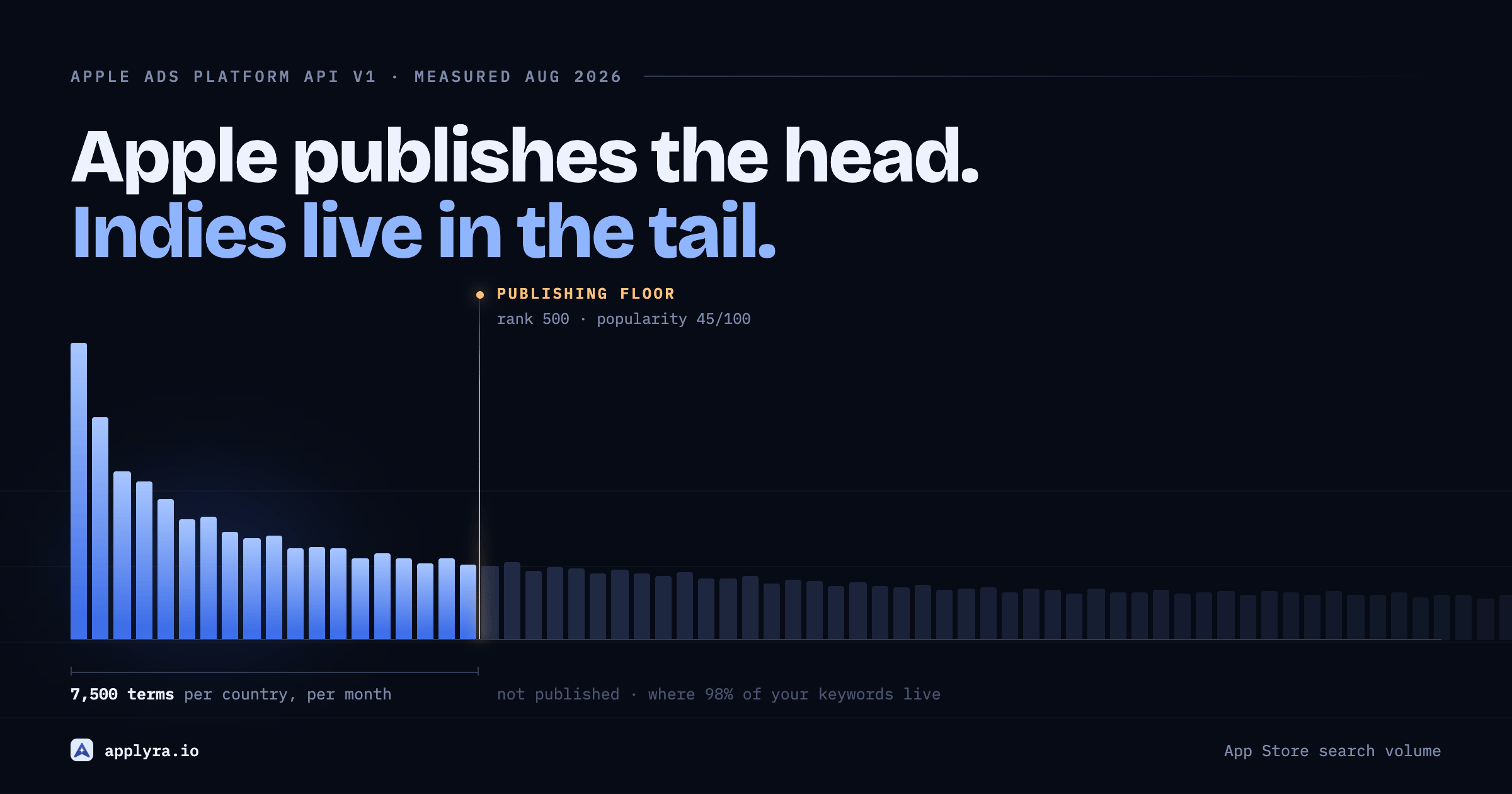
7,500
terms published per country per month
500
hard cap per genre, no matter what you ask for
1.7%
of tracked indie keywords that appear in it
What Apple publishes
The endpoint returns search terms ranked by volume, scoped to an App Store country and a genre. Each row carries a rank inside its genre plus a popularity score, and the score comes in three flavours: relative to the genre, relative to the whole country, and a simplified 1 to 5 tier.
Two details matter more than the rest.
The scores are relative, always. A term at 90 out of 100 is searched more than one at 60. Neither tells you how many people searched it. If you have been reporting "12,400 monthly searches" for an App Store keyword, that number came from a model, not from Apple. This is the single most common thing an AI agent will invent about your ASO, and it invents it fluently.
It is market data, not account data. You do not need a live campaign to read it. We pulled it from an account with zero campaigns and zero spend. That surprised us, because the previous generation of the API refused this kind of request outright.
The history goes back further than the current month, too: 15 months of monthly data and 65 weeks of weekly data, which is enough to see a keyword's seasonality rather than a single snapshot.
How to read a relative popularity score
Think of it as a leaderboard position, not a measurement. Apple is telling you "this term is searched more than that one, by roughly this much." That is enough to prioritise a keyword list. It is not enough to forecast installs, and any tool that converts it into a precise install number is adding a guess on top of Apple's guess.
The ceiling nobody mentions
Here is the part that changes how you should use this data.
Apple publishes 15 genres, and for each one it publishes the top 500 search terms. That is the whole dataset: roughly 7,500 unique terms per country per month.
We checked whether 500 was a paging limit or a real ceiling, because those are very different things. Asking for rank 501 and above returns zero rows. Asking for any term scoring below about 45 out of 100 returns zero rows. It is a publishing floor: Apple has the data and chooses to release the head of the distribution.
The consequence is easy to state and uncomfortable to hear. We matched Apple's dataset against a random sample of the keywords indie developers actually track in Applyra, and 1.7 percent of them appear in it. Split by how much traffic our own scoring gives them:
| Applyra traffic score | Covered by Apple |
|---|---|
| 0 to 19 | 0% |
| 20 to 49 | 1% |
| 50 to 69 | 13% |
| 70 to 100 | 21% |
Even at the very top of the demand curve, four keywords out of five are missing. Below a traffic score of 20, Apple has nothing at all.
That is not a flaw in the API. It is a design choice that fits its purpose: the endpoint exists to help advertisers pick terms worth bidding on, and nobody bids on a phrase searched forty times a month. It just means the data answers a different question from the one an indie developer is asking.
What this means if you are not Duolingo
Try it on a real keyword and the shape of the problem becomes obvious.
Take a French sports betting app. The term "pari sportif" is in Apple's index, sitting around rank 300 of its genre. The phrase "pari sportif gratuit", the kind of qualified, winnable long-tail term a small app would actually target, is not published at all. Same story in English: a broad term like "habit tracker" is there, while the specific phrases around it are not.
The head is the part you cannot win
There is a cruel symmetry here. The keywords Apple publishes volume for are, almost by definition, the keywords dominated by apps with marketing budgets. The keywords you can realistically rank for as a solo developer are precisely the ones Apple does not publish. Official data is most abundant exactly where it is least actionable for you.
This is why "just use Apple's numbers" is not a keyword research strategy for a small app. It is a useful sanity check on your head terms, and it is nothing at all for the tail where your installs will actually come from. Our analysis of 800,000 keyword-market pairs put numbers on that trade-off: median difficulty falls from 37 for a single word to 25 for two, and the share of keywords that are both winnable and worth winning falls with it, from about one in five single words to one in forty at three words.
Apple publishes demand, never difficulty
One more gap worth knowing before you plan around this.
The API gives you no competition signal whatsoever. We went looking for one in every plausible place:
- Impression share reports exist, but they measure your own share of impressions on apps you promote. That is a report card on your campaigns, not a measure of how contested a keyword is.
- Suggested bid amounts exist in the schema, but only inside keyword-level reporting on your own ad groups. No campaign, no bids, no data.
- Recommendations return empty on an account without campaigns.
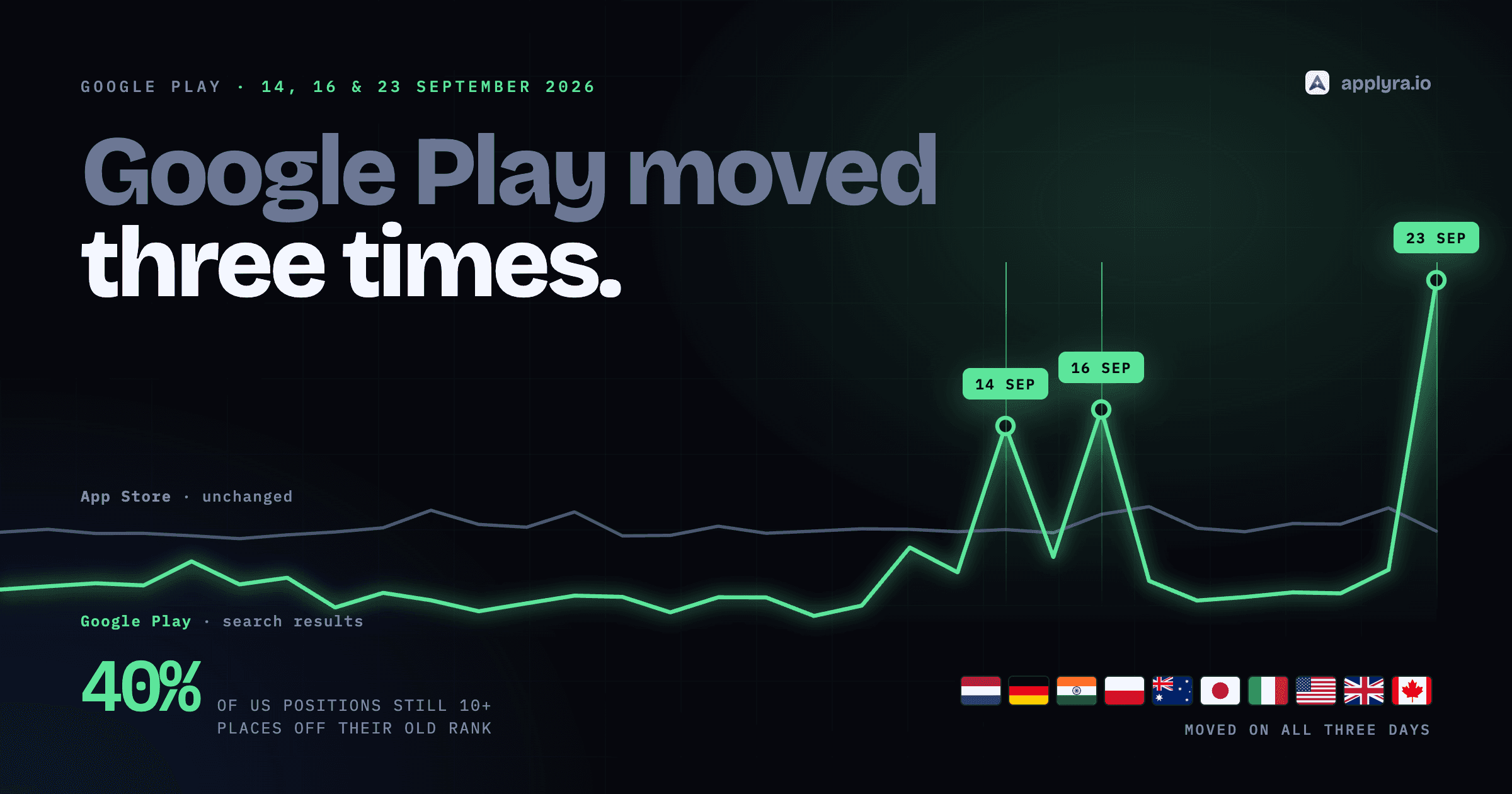
Apple's silence is not limited to difficulty, either. It ships search changes without announcing them, which is how thousands of apps lost their keyword rankings overnight in July 2026 with no notice and no explanation.
So even with the new API, half of the keyword equation is missing. Knowing a term is popular tells you nothing about whether you can break into its top ten, and popularity without winnability is how developers waste a year targeting terms they will never rank for.
What we did with it
Since the data was there, we used it for the one thing it is genuinely excellent at: checking our own work.
Applyra scores every keyword for search traffic without Apple's help, because it has to cover the 98 percent Apple does not publish. That score is built from live store signals, mainly how a term behaves in App Store autocomplete: how early it surfaces, how many suggestions it heads, how broadly it spreads. Until this month there was no independent way to check whether that model agreed with reality.
Now there is. We matched 267 US keywords present in both datasets and compared Apple's popularity ranking with our traffic score:
| Apple popularity | Keywords | Median Applyra traffic score |
|---|---|---|
| 80 and above | 6 | 100 |
| 70 to 79 | 27 | 79 |
| 62 to 69 | 76 | 70.5 |
| 56 to 61 | 98 | 63 |
| Below 56 | 60 | 58 |
Perfectly ordered, across five bands. Of the 109 keywords Apple ranks at 62 or above, not one is scored as dead by our model, and no keyword Apple ranks low is inflated at the top of ours. We ran the same check on French and German keywords and the ordering held.
We are showing you this for a reason that has nothing to do with bragging. Every ASO tool on the market shows you a search volume number, ours included. Until now none of us could point at an outside authority and say "here is the proof our number tracks reality." For the head of the curve, that proof now exists, and it is worth asking your current tool whether they have run the same check.
The practical takeaway
If you do ASO on the App Store, here is how to use all this.
Use Apple's data for your head terms. If a broad, obvious keyword sits in your target list, the API will tell you where it ranks in its genre. Free, official, no campaign needed. Worth checking before you commit a metadata slot to it. Creating an Apple Ads account costs nothing, which is why it belongs in any list of free ASO tools.
Do not expect it to do your keyword research. The terms you can actually win are outside the published set. For those you need a model, and you need to know how that model was built and whether anyone has ever validated it. You can check any keyword's traffic and difficulty in our free keyword tool without an account.
Never mistake a popularity score for a difficulty score. Apple publishes one and not the other. A term at 75 out of 100 might be wide open or completely locked down, and Apple will not tell you which.
If you use the old API, note the deadline. The previous Campaign Management API v5 is being sunset on 26 January 2027. If any part of your stack talks to it, that migration is now on your roadmap.
Search volume for the 98% Apple does not publish
Applyra scores traffic and difficulty on every keyword you track, App Store and Google Play, including the long tail where indie apps actually rank. Free plan, no card.
How we measured this
Everything above comes from reading the Apple Ads Platform API v1 directly, in August 2026, from an Apple Ads account with no campaigns and no spend, using the search term popularity endpoint on the last complete month of data. We pulled seven App Store countries (US, GB, FR, DE, JP, BR, ES) and checked the ceiling from both directions: by paging past rank 500 and by filtering on popularity below the observed floor. Both return nothing.
Coverage figures come from matching that dataset against a random sample of 700 US iOS keywords tracked in Applyra, and the validation table from 267 keywords present in both. Apple's data is used here to describe what the API publishes and to check our own scoring. The numbers Apple publishes stay with Apple.
One caveat worth stating plainly: this is the App Store only. Google Play has no equivalent endpoint, so on Android every search volume number you have ever seen, from any tool, is modelled.
Frequently asked questions
Does the App Store give you search volume like Google does?
Not in the way Google Ads does. Apple publishes a relative popularity score from 1 to 100 for search terms, through the Apple Ads Platform API, and only for the top 500 terms in each of its 15 genres. You never get an absolute number of searches, and anything outside those top terms is simply not published.
How many App Store keywords does Apple publish volume for?
About 7,500 unique terms per country per month. That is 15 genres times a hard cap of 500 terms each. We verified the cap: asking for rank 501 and above returns zero rows, and so does asking for any term scoring below roughly 45 out of 100. It is a publishing floor, not a paging limit.
Can I look up the search volume of one specific keyword?
Yes, if the term is in that top-500 index. The API accepts an exact match and a contains match on the search term, so you can query one keyword or search a substring. If the term sits outside the published head, the query simply returns nothing, which is the case for most long-tail phrases.
Do I need to run Apple Ads campaigns to access this data?
No. We read the search term popularity endpoint from an account with zero campaigns and zero spend. You need an Apple Ads account with an API user role and an ad account, but no active campaign and no budget.
Does Apple publish keyword difficulty or competition data?
No. Apple publishes demand only. Impression share reports measure your own share on apps you promote, not how contested a keyword is, and the suggested bid amount only exists inside reporting on your own ad groups. There is no market-level difficulty signal to read.
What about Google Play search volume?
Google Play publishes nothing comparable. There is no official search volume endpoint for the Play Store, so every number you see in an ASO tool for Android is modelled from other signals, such as autocomplete behaviour and ranking data.
Ready to optimize your app?
Start tracking keywords and improving your app visibility on both stores - free, no credit card required.