Keyword work does not slip because it is hard. It slips because checking it means stopping what you were doing, opening a tab, logging in, and remembering what you were looking for in the first place.
That tax is the whole reason an ASO MCP server exists. Not because chat is a better interface than a table. Because the question gets asked at all when asking costs nothing.
I have been running my own ASO this way for a while now. Some of it works better than the dashboard. Some of it is a trap. Here is both.
What this covers
Prompts you can paste today, mapped to the tools an ASO MCP server actually exposes. Then the four places an agent will confidently get App Store Optimization wrong, and the one habit that catches all four.
What actually changes
An MCP server is not an AI feature. It is a socket. Your assistant gets a list of tools, each with a name and a schema, and it decides which to call.
For ASO that means the model stops reasoning about your app from memory and starts reading it. list_keywords returns your tracked terms with their current rank. inspect_keyword scores a term for difficulty and traffic. run_autocomplete asks the store what it suggests as people type. list_competitors puts your visibility next to theirs.
The difference is not convenience. It is that the answer changes when the data does.
The prompts that earn their keep
Monday triage
The one I actually use every week:
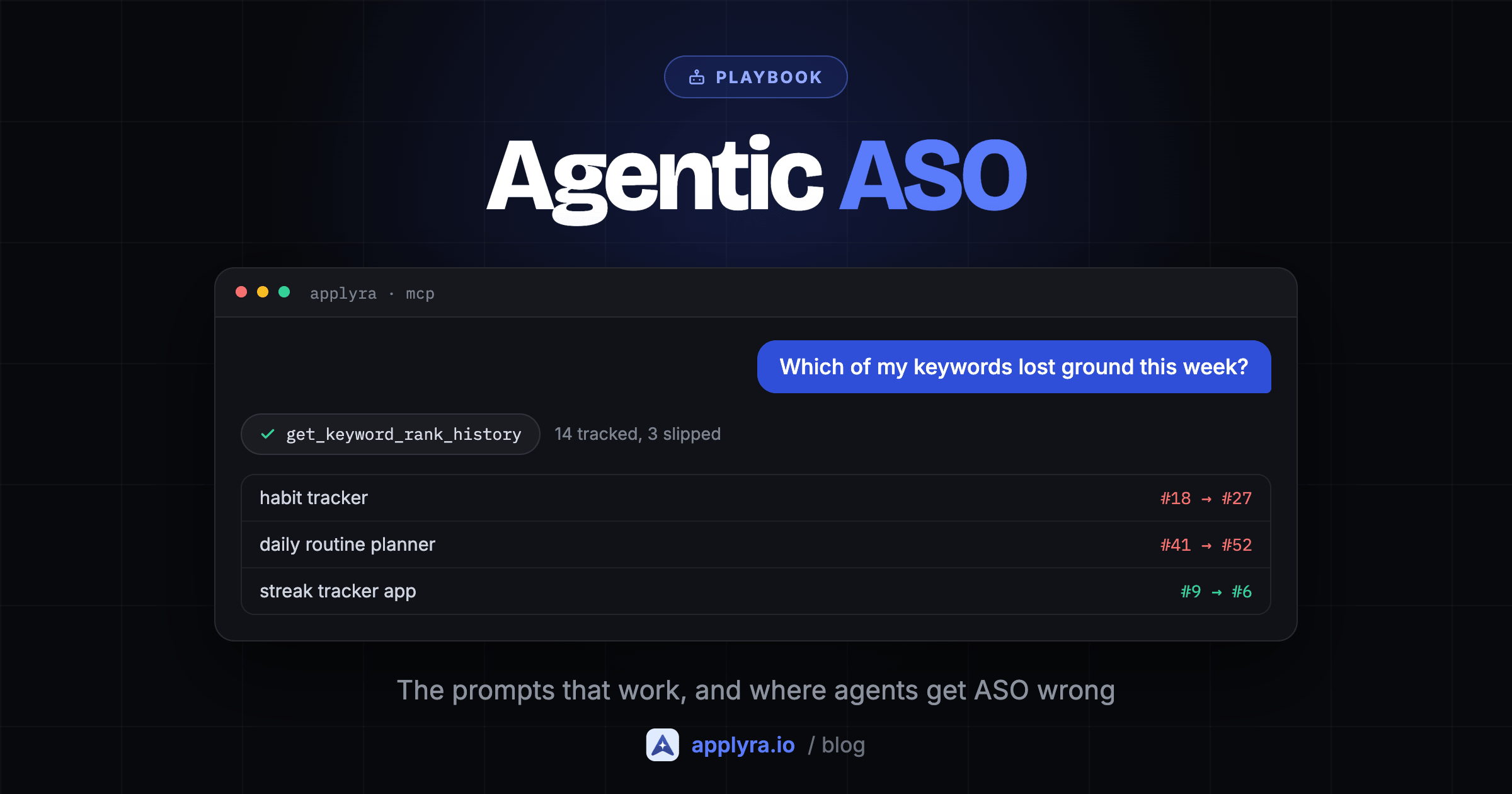
Which of my tracked keywords lost ground in the last 7 days? Show the before and after rank, worst first, and skip anything that moved less than 3 places.
That last clause matters. Store ranks jitter. Without a floor you get a wall of plus-one-minus-one noise and you stop reading it by week three.
The agent calls list_keywords then get_keyword_rank_history. What comes back is a short list you can act on, which is the only kind anyone reads.
Mine the autocomplete
Store autocomplete is the closest thing to a free demand signal either platform gives you. It is what real people typed, ranked by how often they typed it.
What does the App Store suggest when someone starts typing "habit" in the US? Score each suggestion and flag the ones I already rank for.
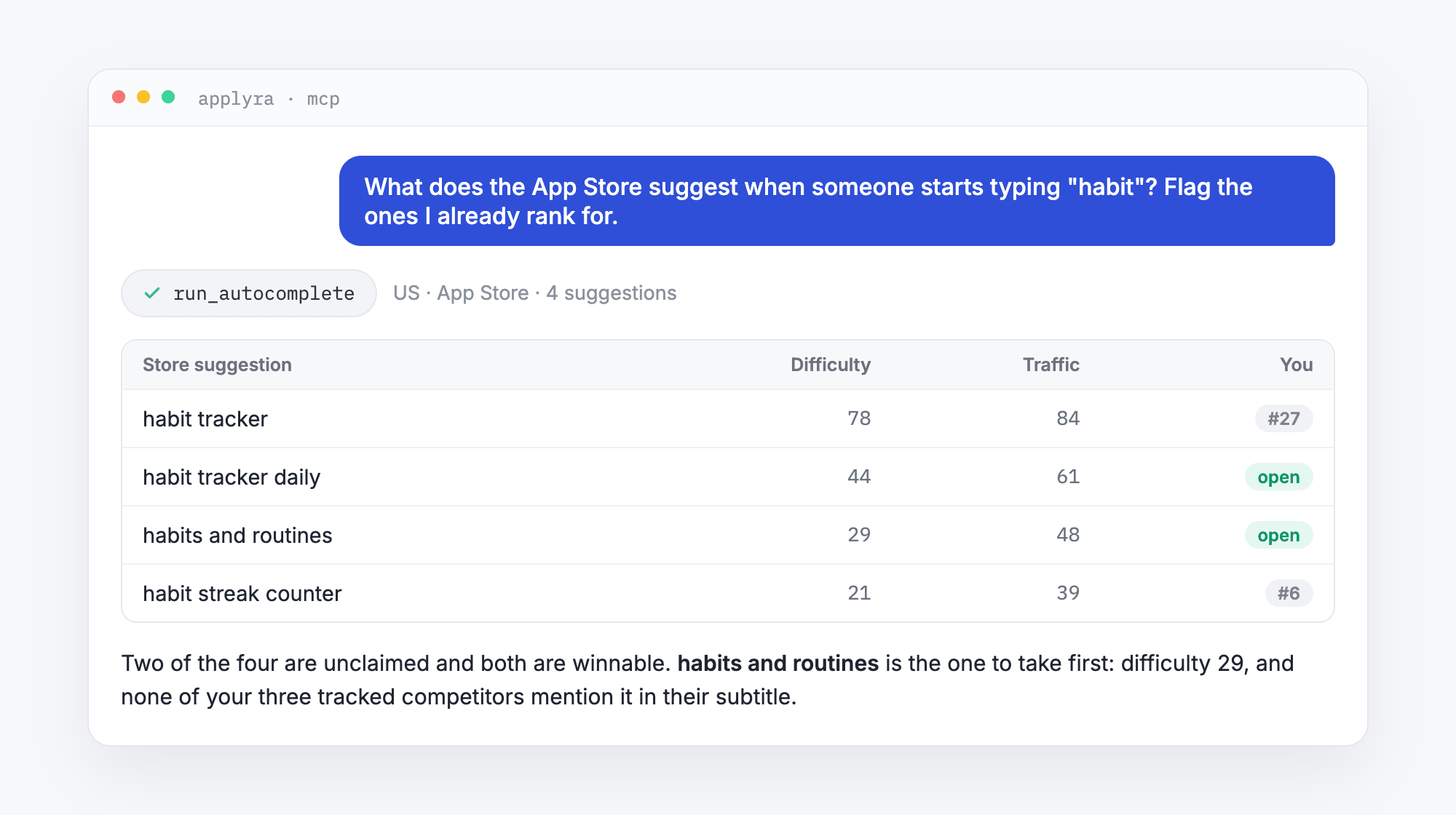
Two calls, one answer, no export. The flagging is the part a dashboard makes you do with your eyes.
Pick the next fight
Of my untracked keywords with difficulty under 40 and traffic over 30, which three are closest to my current subtitle wording? Explain why each one is winnable.
Difficulty under 40 with traffic over 30 is a real threshold, not a round number I picked. It is the bar we used across 800,000 keyword-market pairs, and what clears it depends almost entirely on length: 19.5 percent of App Store single words and 22.4 percent on Google Play, against 2.5 and 3.8 percent at three words. Ask the agent for the slice, not for the tail.
Read a rival's release
Compare my listing to my top competitor. What did they change in their title or subtitle since last month, and which keywords did they gain rank on after that?
This is the query that pays for the whole setup. A competitor changing their subtitle is a hypothesis they ran for you. If their ranks moved after, you learned something for free.
Find the open room
Break my category into sub-niches and rank them by how open they are. For the most open one, tell me what a first release would need in the title to compete.
run_niche_analysis clusters the space; the second sentence is what turns a report into a decision. Ask for the report alone and you get a report alone.
Watch the chart you are not in yet
Who entered the top 20 of US Productivity on the App Store this week, and what do the new entries have in common in their metadata?
Category charts are a leading indicator. Something breaking into the top 20 usually did something you can see in its listing.
Ready to optimize your app?
Start tracking keywords and improving your app visibility on both stores - free, no credit card required.
Where agents get ASO wrong
This is the half nobody writes about, and it is the half that will cost you a release cycle.
They invent search volume
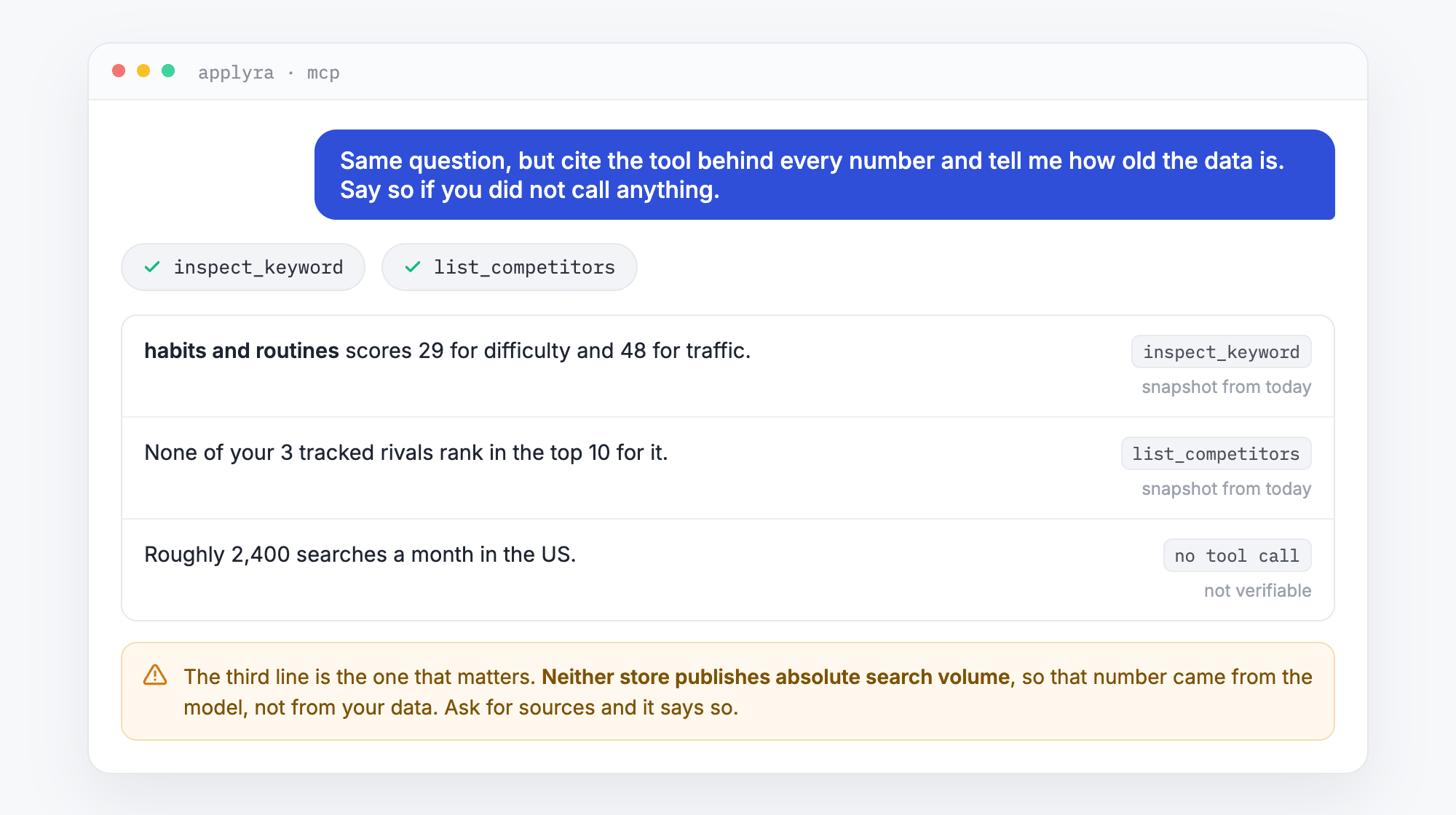
Ask any assistant how many people search "habit tracker" a month and you will get a number. Confident, specific, plausible. Almost always fabricated.
Absolute search volume for app stores mostly does not exist publicly. Apple publishes a relative popularity index from 1 to 100, and only for roughly the top 500 terms of each genre, which is about 1.7 percent of the keywords indie developers actually track. Google Play publishes nothing.
So when a model hands you "2,400 searches a month", it is not reading. It is completing a sentence.
They cannot count characters
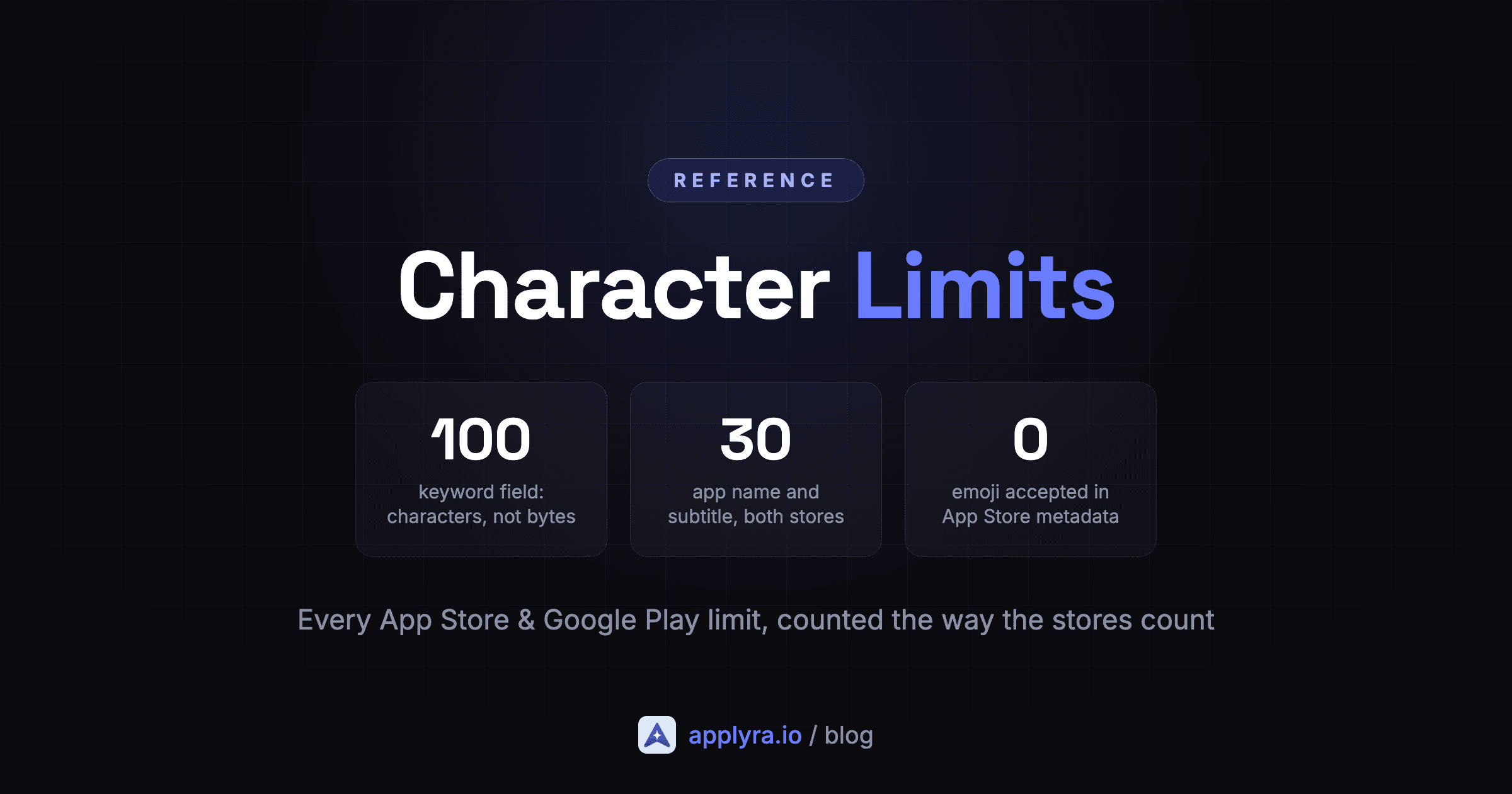
Models are bad at counting, and app store fields are unforgiving. Thirty characters for a title. Thirty for a subtitle. One hundred for the iOS keyword field.
Worse, both stores count UTF-16 code units, not letters. An emoji is two. An accented character can be two. Ask a model to "write a 30 character subtitle" and you will get 33, or 28 with an emoji it thinks is one. And App Store Connect rejects emoji outright in every metadata field whatever the guideline says, so the model will happily draft something that cannot be saved.
Draft with the agent. Count with a validator.
They pad the keyword field
Ask for 100 characters of iOS keywords and watch it produce fitness,fitness tracker,fitness app,track fitness.
Apple already tokenizes and recombines. Repeating a word you have used once buys nothing and burns characters you will want later. Same for plurals in most cases, same for your own app name, which is already indexed.
The prompt that fixes it: no word may appear twice across the whole field, no plurals, no words already in my title or subtitle.
They aim too high
Give a model your category and ask for keywords and it will hand you the head terms. They are the most represented in its training data, so they are the most available to it.
Head terms are also the ones you will not win this year. The agent has no idea what your app's authority looks like, which is exactly what the difficulty score is for. Anchor every request in a number: under 40 difficulty, where I already rank top 50, where no tracked competitor is in the top 10.
Make it show its work
One habit catches all four failures.
From now on, for every number you give me, name the tool you called and when the data is from. If you did not call a tool, say the number is your estimate.
That is it. A model asked to attribute stops padding, because a fabricated figure has nowhere to point. You will see it in the second answer: the invented search volume comes back labelled as an estimate, or does not come back at all.
The rule that survives contact
Never accept a number that did not come from a tool call. If the agent cannot name the call, treat the figure the way you would treat a stat from a stranger on the internet.
Two more that pay for themselves: ask for the country and store on every answer, because ranks are per market and a model will happily blend US and GB data into one number. And ask what it did not check, which surfaces the tool it should have called and didn't.
Setting it up
Roughly a minute. The server runs locally through npx, so there is nothing to host and no OAuth flow to sit through. You generate an API key, paste one snippet into your client's config, restart it.
Claude Code and Codex are one line each, and the flags differ, which is worth knowing before you lose ten minutes to it:
claude mcp add applyra -e APPLYRA_API_KEY=your_api_key -- npx -y @applyra/mcp-server
codex mcp add applyra --env APPLYRA_API_KEY=your_api_key -- npx -y @applyra/mcp-server
Claude Desktop, Cursor, VS Code and Windsurf take a JSON block instead. The Applyra MCP server page has the snippet for each, plus what all twenty tools return.
One boundary worth stating plainly: the tools can read your data and change things inside your Applyra account, like tracking a keyword. They cannot publish to App Store Connect or Google Play. That step stays yours, which is the right default when a model can write a subtitle in one turn and be wrong about the character count in the same breath.
The honest summary
Agentic ASO is not a new discipline. It is the same keyword work with the friction removed, which mostly means you do it weekly instead of quarterly.
The gain is real and boring: questions get asked. The risk is also real and less boring: a fluent wrong answer is harder to catch than a blank dashboard. Make it cite its tools and the risk mostly goes away.
Start on the free plan, track a handful of keywords for a couple of weeks so there is history worth querying, then connect the agent. Asking an empty database what moved is a short conversation.
Frequently asked questions
What is an ASO MCP server?
MCP, the Model Context Protocol, is an open standard that lets an AI assistant call external tools. An ASO MCP server exposes App Store Optimization data as those tools: keyword ranks, difficulty and traffic scores, competitor positions, store autocomplete. Instead of exporting a CSV and pasting it into a chat, you ask a question and the assistant fetches the current numbers itself.
Which AI clients can run an ASO MCP server?
Any client that speaks MCP. Applyra publishes setup snippets for Claude Desktop, Claude Code, Cursor, OpenAI Codex, VS Code with GitHub Copilot, and Windsurf. The server runs locally over stdio through npx, so there is nothing to host. ChatGPT web is the exception: it only connects to remote HTTPS servers and cannot start a local process.
Can an AI agent change my App Store listing?
Not through Applyra. The tools can change things inside your Applyra account, such as tracking a keyword or adding a competitor, and they can read your data. Publishing metadata to App Store Connect or Google Play stays a deliberate step you take yourself, which is the right default when a model can write a subtitle in one turn.
Why does my AI assistant invent App Store search volume?
Because absolute search volume mostly does not exist publicly, so the model fills the gap. Apple publishes a relative popularity index from 1 to 100 for roughly the top 500 terms of each genre, and Google Play publishes nothing at all. Any assistant quoting you a precise monthly search count for a long-tail app keyword is generating it, not reading it.
Do I need a paid plan to use an ASO MCP server with Applyra?
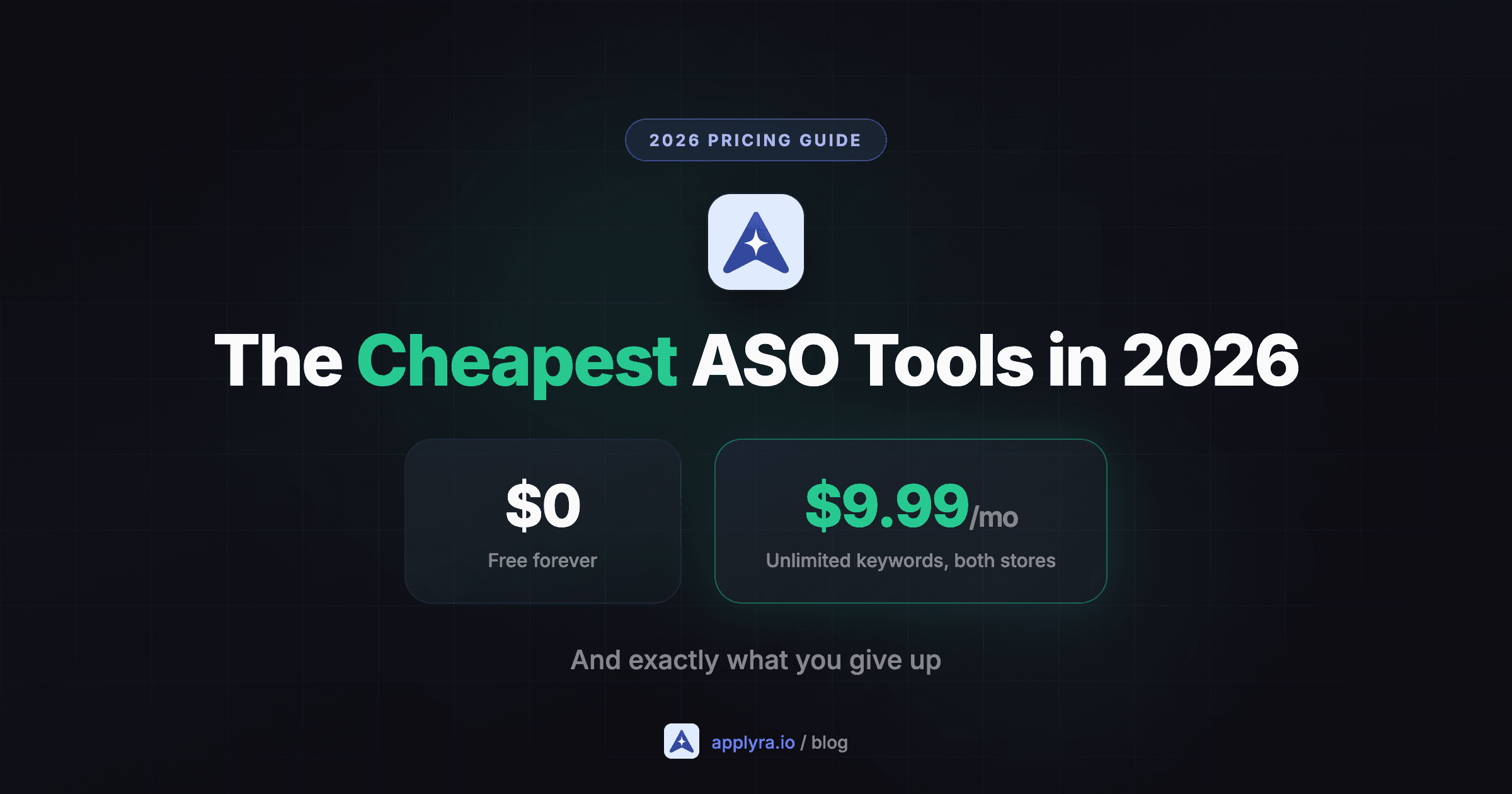
Yes. The MCP server authenticates with the same API key as the REST API, and API access is part of the Unlimited plan at $9.99 a month. The free plan is permanent and covers 1 app, 5 keywords and 1 competitor, so you can build up real tracking data first and connect the agent once there is something worth asking about.
Ready to optimize your app?
Start tracking keywords and improving your app visibility on both stores - free, no credit card required.