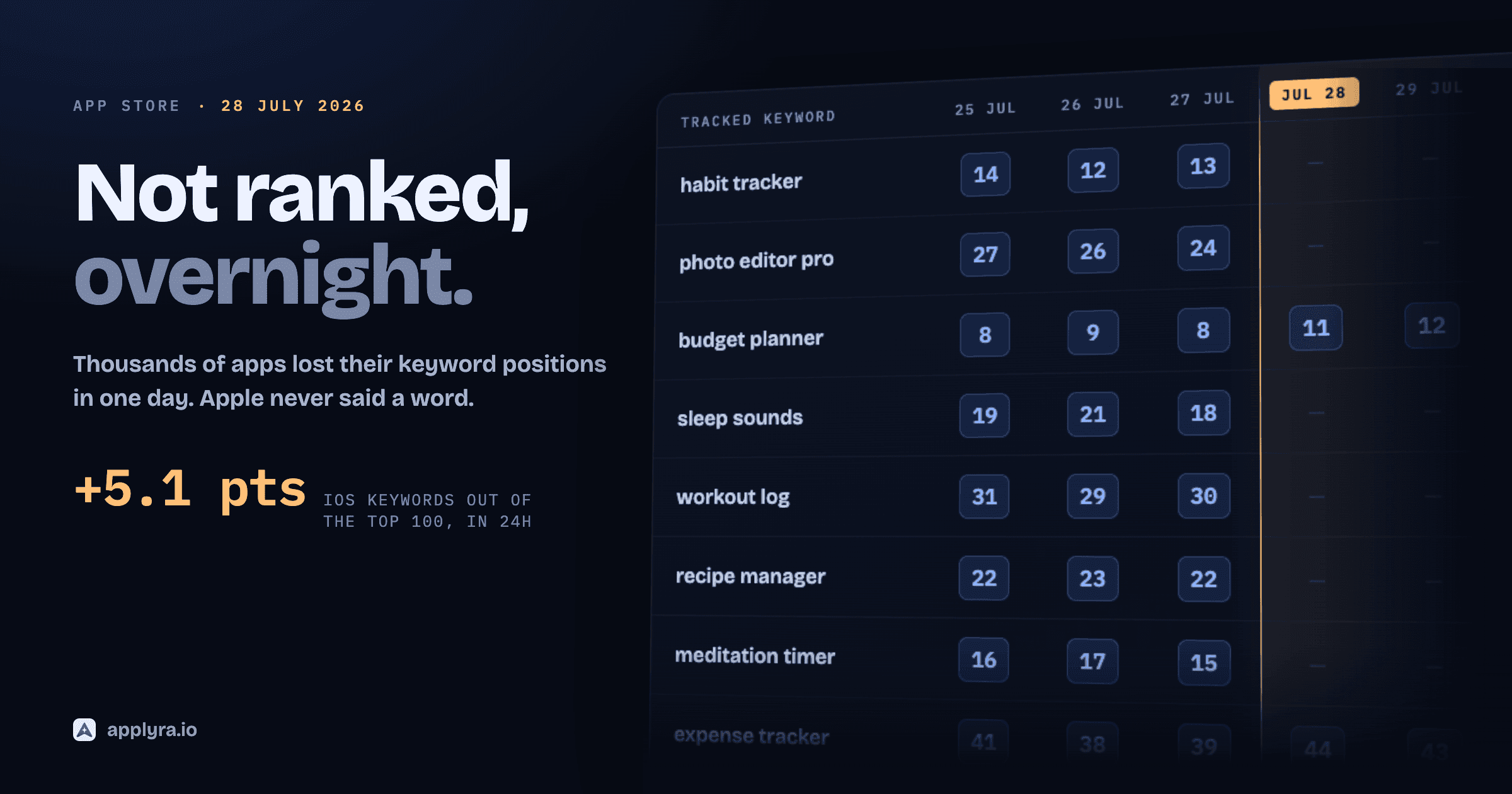
Your App Store keyword rankings dropped overnight and half the list is simply gone. Not ranked 40 instead of 12. Gone. The column that said 8, 14, 22 yesterday says nothing at all today.
The instinct is to fix it immediately. Rewrite the subtitle, swap the keyword field, ship an update tonight. Resist that for about ten minutes, because the first question is not how do I fix this. It is did I break this, or did the store?
Those two situations look identical in your dashboard and need opposite responses. Guess wrong and you spend a week rewriting metadata that was never the problem, while destroying the only clean data you had about what actually happened.
Before you touch anything
Do not ship a metadata change on the day rankings fall. A release re-triggers indexing, which means you can no longer tell the store's behaviour from your own change. Wait for two or three data points first. The rankings are already gone; a two-day delay costs you nothing and buys you the ability to diagnose.
Start with a control
Here is the fastest diagnostic in ASO, and it takes about a minute.
Look at the same app, over the same days, on a store you did not touch. If you ship on both, Google Play is your control group. Your app is the same app, your reviews are the same reviews, your release was the same release. The only thing that differs is the ranking engine.
Then read the two together:
- Both stores fall. The cause is you. A release, a rating collapse, a metadata edit, a pricing change. Go look at what you shipped.
- One store falls, the other is flat. The cause is that store. Nothing in your listing changed on one platform and not the other.
That is it. It works because a store-wide event is indifferent to your app, so it cannot show up on a platform that did not run it. And it does not need a tool, just two ranking histories side by side. The catch is that you need the history before the drop, and nobody starts tracking on the day things break.
If you only ship on iOS, you can still run a weaker version of it: compare your app against two or three competitors you track. If everyone in your niche fell on the same day, it was not your subtitle.
What a store-wide ranking drop looks like in data
Applyra re-checks close to half a million keyword-and-app pairs every day, across both stores. That is the only reason a post like this can exist: when a store changes something quietly, the before-and-after already sits in the database. Here is what one looks like when you plot it properly.
Share of tracked keyword pairs sitting outside the top 100, day by day, late July 2026:
| Date | iOS | Google Play |
|---|---|---|
| 24 July | 71.1% | 60.1% |
| 25 July | 71.3% | 60.2% |
| 26 July | 71.2% | 60.2% |
| 27 July | 71.9% | 60.2% |
| 28 July | 76.3% | 60.9% |
| 29 July | 76.2% | 61.0% |
| 30 July | 76.1% | 61.2% |
Five points of the tracked set left the top 100 on iOS in twenty-four hours, and stayed out. Google Play, over the same week, moved by less than a point, which is its normal daily noise.
Why the flat column is the important one
The iOS jump on its own proves nothing. A scraper outage, a proxy problem, a parsing bug on our side would all produce exactly that shape. The reason we can call this a real store event is the column next to it. Both stores run through the same pipeline, the same infrastructure, the same day. One moved, one did not. Whatever happened, it happened at Apple.
This is worth stealing for your own diagnosis. A number that moves is a story. A number that moves while its control stays flat is evidence.
The July 2026 case
That week was not a quiet one. Around 26 and 27 July, ASO practitioners across several regions reported apps losing ranked keywords at a scale well outside normal volatility, with third-party trackers putting the peak near 94,000 affected apps in a day and more than 16,000 in the US alone.
The texture of the loss is what made it unusual. Rankings normally drift: 12 becomes 19, 19 becomes 31, and eventually you fall off the bottom. Here, terms went straight from ranked to Not Ranked with no slide, which reads much more like re-indexing than like competition.
Apple said nothing, then and since. That is normal. Apple does not publish search changes, does not version them, and does not confirm them afterwards, which is precisely why your own tracked history is the only record you will ever have of one.
It did not come back
The part that matters for planning is what happened next. Nothing.
Five weeks on, our tracked iOS pairs sit at 76.9 percent outside the top 100. Google Play sits at 60.0 percent, which is where it was in July, and in June. The iOS level never returned to 71 percent. It found a new floor and stayed there.
+5.1 pts
iOS keywords out of top 100, in one day
0.7 pts
Google Play move, same week
5 weeks
and still no recovery
So the honest framing is not "iOS had a bad week in July". It is that the bar moved. If your keyword strategy was calibrated before that date, part of it is calibrated against a store that no longer exists.
And then Google did it, seven weeks later
One caveat on the control test, because it is the reason this post cannot stay purely about Apple. Google Play is an excellent control right up until Google is the one that moved.
On Monday 14 September 2026, Google Play rewrote its search results in every major market at once. Germany ran at 6.7 times its ordinary day, Canada at 6.2, Australia at 6.0, the United States at 5.4. In the US that meant 51% of measured keywords moving 10 places or more, against 4% on a normal day, with the typical keyword moving 10 positions in twenty-four hours. The App Store read 1.0x in every major market the same day, so the columns simply swapped: this time Apple was the flat one.
It stuck, exactly like July. Roughly 9 out of 10 positions that moved were still within 2 places of their new rank a day later. It also opened doors rather than only closing them: 1 in 8 US positions that day was held by an app that had not been in the top 100 for that search the day before, against something closer to 1 in 90 on an ordinary day.
So run the diagnostic in both directions. Android down and iOS flat is not evidence that your Play listing is broken; it is the exact shape of 14 September. The market-by-market measurement is in Google Play's biggest algorithm update of 2026.
What this changes for you, concretely
Your historical ranking data has a seam in it. Any before-and-after you run across late July is measuring the event, not your work. If you changed your subtitle on 20 July and judged it on 5 August, you learned nothing about your subtitle. Re-run that test on clean dates.
Difficulty scores moved too, everywhere. Every ASO tool computes difficulty from who currently ranks. Change who ranks and every difficulty number shifts, in every tool, whether or not the vendor mentions it. If you keep a spreadsheet of "keywords I can win" built before August, it is stale. We re-derived ours after the event, and the reasoning behind the current numbers is in our study of 800,000 keywords.
Mid-table positions were hit hardest. The top of the ranking is comparatively stable across these events, because established apps have signals no recalibration erases overnight. It is positions 11 to 30, the ones you actually fight for as an indie, that churn. That is exactly the band where a small app's visibility lives.
Do not chase it with a rewrite. The single most expensive reaction to a store-wide event is a panic release. You reset your own indexing at the worst possible moment, and you add your variable on top of theirs.
When it really is you
Control test came back the other way, both stores down together? Then it is yours, and the causes are boringly consistent:
- You shipped. A release can re-index your listing and shuffle rankings for several days, even when the metadata is unchanged. Look at the dates before you look at anything else, and remember that a metadata change lands on day one: a drop that starts a week after your release probably is not your release.
- Your rating fell. A drop from 4.6 to 4.2 is enough to push you off page one on competitive terms, because conversion feeds ranking on both stores.
- You edited the field that was working. The keyword field and the subtitle carry most of your iOS indexing. Rewriting them is the fastest way to lose terms you had.
- Someone else moved. You did not fall, a competitor rose. Same numbers on your screen, completely different problem, and the only way to tell them apart is a dated record of what your competitors changed.
I go through these in more depth, with the fixes, in 10 ASO mistakes indie developers make. And if you are still building the foundations, the complete ASO guide for indie developers covers what to get right before you start diagnosing.
The takeaway
Ranking drops feel personal. Most of the big ones are not.
Keep enough history to run the control test, on both stores if you ship on both, and you turn a panic into a five-minute diagnosis. Skip it and you will spend a week rewriting a subtitle that was never the problem, which is the actual cost of not having the data.
That is the boring, unglamorous case for tracking rankings daily: not to watch the numbers go up, but to know which numbers are yours. Applyra keeps that history on both stores, scores every keyword's difficulty and traffic so you can see when the ground moved under them, and has a permanent free plan to start. You can also check any keyword's difficulty and traffic with the free keyword tool, no account needed.
Apple did it again on 8 October 2026: 54% of US keywords moved 10 places or more in a single day while Google Play held steady, as we measured in the October 2026 App Store algorithm update. It never announces it. The only question is whether you will have the data to recognise it next time.
See the measurement behind this
App Store search volatility, by country, updated every day and free to read.
Open the algorithm change detectorFrequently asked questions
Why did my App Store keyword rankings drop suddenly?
There are two families of cause and they need opposite responses. Something changed on your side, such as a release that reset your indexing, a rating drop, or new metadata. Or something changed on the store's side, in which case thousands of apps moved at the same hour and nothing you do to your listing will bring the rankings back. Check which one it is before touching anything.
How can I tell if a ranking drop is my fault or the App Store's?
Use a control. Look at the same app on a store you did not touch, usually Google Play, over the same days. If both stores fall together, the cause is your app or your metadata. If only one store falls while the other stays flat, the cause is that store. This is the single fastest diagnostic and it costs nothing.
What happened to App Store keyword rankings in July 2026?
Around 26 and 27 July 2026, iOS apps lost ranked keywords at a scale well above normal volatility, with previously ranked terms flipping straight to Not Ranked rather than drifting down. In Applyra's tracked set, the share of iOS keyword pairs sitting outside the top 100 rose from 71.2 to 76.3 percent in a single day on 28 July, while Google Play stayed flat. Apple never announced anything.
Do keyword rankings come back after a store-wide event?
Not always, and this one did not. Five weeks after the July 2026 event, our tracked iOS pairs were still at 76.9 percent outside the top 100, against a stable 60 percent on Google Play. The new level held. Treat a store-wide recalibration as a new baseline to work from, not a dip to wait out.
Did Google Play have a store-wide ranking event in 2026?
Yes, on Monday 14 September 2026, and it was the biggest of the year. Google Play search results changed in every major market at once: in the United States 51 percent of measured keywords moved 10 places or more, against 4 percent on a normal day, while the App Store sat at its ordinary level. The control test runs both ways, so a drop on Android while iOS stays flat does not mean your Android listing is broken.
Should I change my keywords after a sudden ranking drop?
Not on day one. If the drop is store-wide, rewriting your metadata changes your indexing for no reason and destroys your ability to read what happened. Wait for two or three days of data, confirm with a control store, then decide. If the drop is genuinely yours, the fix is usually in what you shipped, not in the keyword field.
Ready to optimize your app?
Start tracking keywords and improving your app visibility on both stores - free, no credit card required.