Ask how long App Store metadata changes take to work and you get the same answer everywhere. Four to six weeks. It is in agency decks, tool blogs and every Reddit thread on the subject, and nobody ever says where the number came from.
We had the data to check it, so we checked it.
The short answer
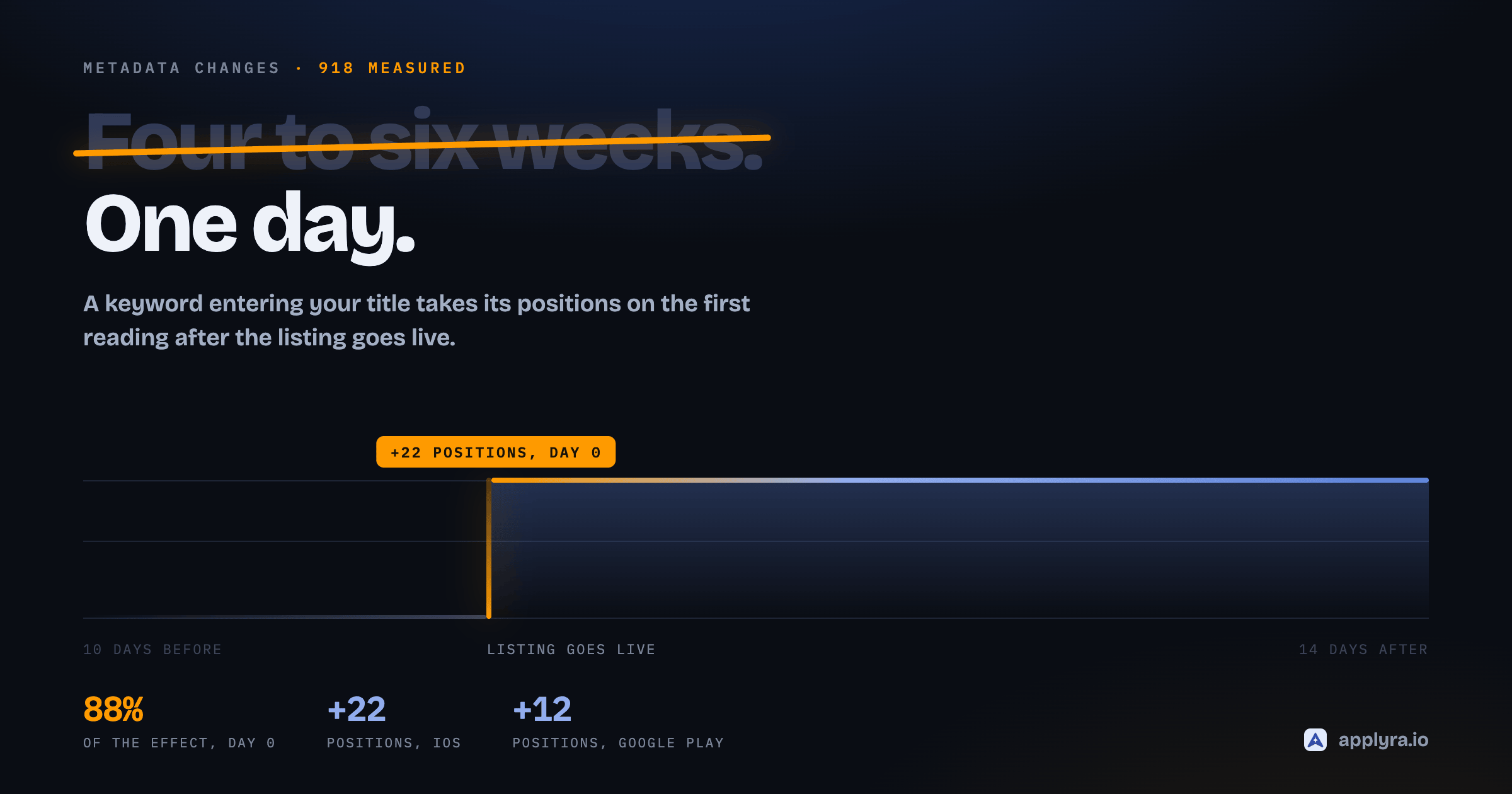
The store is not slow. A keyword entering your title gains 22 positions on iOS the same day the listing goes live, which is 88 percent of everything it will ever gain. Google Play delivers 74 percent on day zero and finishes inside two weeks. The four-to-six-week wait is not the store re-indexing. It is you, waiting for enough data to read the result. Applyra tracks that daily and for free, which is the only reason this was measurable at all.
That distinction is worth real money. The six-week myth tells you to ship a change and look away, which is exactly when you lose the ability to attribute anything. It also gives a bad change five weeks to sit there before you think about reverting it.
What we measured
918
real metadata changes measured
1,126
control keywords from the same apps
88%
of the iOS effect present on day zero
The hard part of this question is not the data, it is the confound. Apps that change their title are not a random sample. They are apps in motion, shipping features and running campaigns. Compare them against other apps and you measure ambition, not metadata.
So each app is its own control. For every listing change, we split that app's tracked keywords in two: the ones that entered the title at that release, and the ones the release did not touch. Same app, same niche, same reviews, same week. Only the string moved. Anything that hits the whole app equally, including a store-wide shake-up, lands on both groups and cancels out.
Then we tracked both groups daily, from ten days before the change to fourteen days after, and measured every keyword against its own pre-change baseline.
How long it actually takes: day zero
Positions gained by treated keywords over and above the same apps' untouched keywords. Higher is better.
| iOS | Google Play | |
|---|---|---|
| The 3 days before the change | +1 | +2 |
| Day zero | +22 | +12 |
| Days 1 to 3 | +24 | +10 |
| Days 4 to 7 | +24 | +12 |
| Days 8 to 14 | +25 | +16 |
Read the first two rows together. In the days before the change these keywords were doing nothing in particular. Then the new listing goes live and they jump twenty-two places. The line barely moves after that.
Losing a keyword is just as fast
We measured the reverse too. Across 178 removals, a keyword dropping out of the iOS title lost 18 positions on the first reading and settled around 22 worse. The store giveth and taketh away on the same schedule. There is no grace period on a title edit you regret.
One honest note on precision. Our tracking runs daily, so "day zero" means "the first daily reading after the listing was live", not "within six hours". The real resolution is about a day. That makes the finding stronger, not weaker: whatever Apple and Google do, they do it inside the smallest window we can see.
This is the same conclusion we now carry in 10 ASO mistakes indie developers make: the ranking moves within a day, and the weeks you spend afterwards are measurement, not processing.
Then why does everyone say six weeks?
Because six weeks is roughly how long it takes to read the result. People are describing their own measurement latency and calling it the store's.
We quantified the noise. We took every tracked keyword belonging to an app that shipped no listing change at all over two weeks, and looked at what those ranks did day to day. Nothing was touched. This is the sound of an app sitting still.
| Day-to-day movement, quiet apps | iOS | Google Play |
|---|---|---|
| No movement at all | 79% | 73% |
| Moved 5 positions or more | 7.3% | 9.1% |
| Moved 10 positions or more | 4.5% | 5.6% |
Measured over 453,524 keyword-day pairs. Most keywords do not move on most days. But the tail is fat, and that tail is what wrecks your reasoning.
The number that explains the myth
Track 20 keywords and, on a completely uneventful day, one or two will move five positions or more. About one a day will move ten or more. Nothing happened. That is just what ranks do.
Now put yourself back on the day after a metadata change. Three keywords went up, two went down, one jumped fourteen places. Is that your subtitle? You cannot tell, because you would have seen the same picture if you had shipped nothing.
So you wait. Six weeks later the pattern is finally obvious, and you conclude the store took six weeks. It took a day. You took six weeks.
See the day your listing changed, on the same chart as your ranks
Applyra records every metadata change on your apps and your competitors', and marks it on the ranking history so you can read cause and effect. Free plan, no credit card.
What this changes about how you work
A schedule that matches the data
Day 0. Ship one change at a time and note the date. Change the title and the screenshots together and you have permanently lost the ability to tell which one did anything.
Day 1 to 3. Look, do not act. The store has already re-indexed you. Your keywords have also moved for six unrelated reasons.
Day 7. First real read, across the whole keyword set.
Day 14. Decide. Keep it or revert it.
Three rules fall out of the measurement.
One change per release. This is the whole ballgame. Our measurement only worked because we could separate touched keywords from untouched ones inside the same release. You need that same separation.
Judge sets, not keywords. A single keyword is noise with an opinion. Ten keywords that all entered the title at once are a signal.
Never ship a fix on top of a change you are still measuring. Re-indexing restarts and your clean before-and-after becomes two overlapping experiments.
Which metadata field moves rankings the most?
Speed is one question, size is another, and the fields are wildly unequal. Same control design, measured across the summer of 2026:
| Field | Positions gained on entry, iOS | Google Play |
|---|---|---|
| Title | +22 to +25 | +12 to +18 |
| Subtitle / short description | +6 to +10 | +4 to +6 |
| Long description | under +1 | under +1 |
| iOS keyword field | under +1 | not applicable |
Two things worth sitting with.
The long description is not a ranking lever. A keyword entering it moves under one position. Apps that mention a word a lot tend to be about that word, which is why cross-sectional data suggests otherwise, but once each app is compared against itself the effect collapses. Write the description for the human reading it.
The iOS keyword field holds ground rather than taking it. Entering it gains under a position; across 80 measured removals, leaving it costs about 12 and takes the top-10 rate from 6.1 percent to nothing. It is insurance for terms you cannot fit in the title or subtitle. If you are deciding what goes in those 100 characters, our character limits reference has the real counting rules, which are not the ones Apple's documentation states.
Where the measurement stops
Being straight about the edges is the only thing that makes the middle trustworthy.
This measures keyword rank, not downloads. Ranking sooner does not mean installs arrive sooner. Impressions have to accumulate and conversion is a separate problem with its own clock, which is why our own ASO mistakes guide still puts meaningful download growth at four to eight weeks. Both things are true: the ranking moves in a day, the business result takes longer.
The latency was measured on title changes, the strongest lever available. A weaker field produces a smaller effect, and a smaller effect takes longer to become visible against the noise. The store's clock does not change. Your ability to read it does.
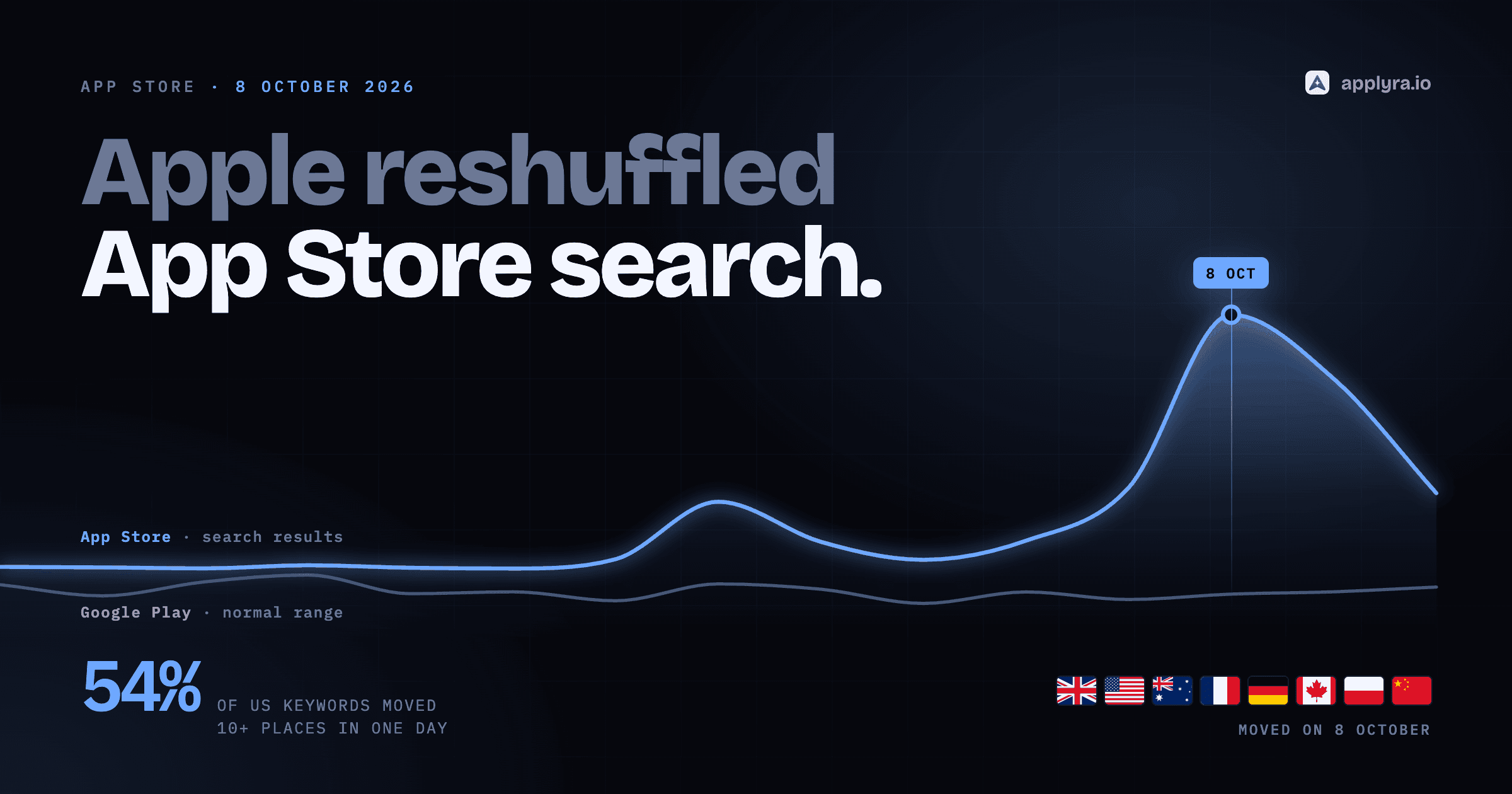
And this is one panel of tracked apps over one summer. Stores recalibrate: we watched Apple do exactly that in July 2026, which is a useful reminder that any measurement of a store is a measurement of a moment.
The takeaway
The store is fast. Your instruments are slow.
If you have been shipping a metadata change and then waiting a month before looking, you have been throwing away the most informative days of the experiment. The signal is there on day one. What you need is not more patience, it is a daily record of every keyword plus a note of exactly what you changed and when, so that in two weeks the answer is sitting there instead of being reconstructed from memory.
That part is not hard. It is just the part nobody sets up before they need it. Applyra's free plan tracks a real app with daily history and no card, which is enough to run your next metadata change properly instead of guessing at it.
Frequently asked questions
How long does it take to see results after changing app store metadata?
About a day. Applyra measured more than 900 real listing changes against 1,126 untouched control keywords from the same apps. A keyword added to the title had already gained 22 positions on iOS and 12 on Google Play by the first daily reading after the new listing went live. On iOS that is 88 percent of the total effect, landing on day one.
Why do people say ASO changes take four to six weeks?
Because four to six weeks is how long it takes to read the result, not to cause it. Individual keyword ranks move on their own every day, so a few keywords over a few days tell you nothing. The store re-indexed you on day one. You needed two weeks of daily tracking before the signal separated from that noise.
How long should I wait before judging a metadata change?
Two weeks of daily rank data, judged across your whole keyword set rather than one term. On a quiet day with no listing change at all, roughly one tracked keyword in twelve still moves five positions or more. Watch twenty keywords in Applyra and one or two will look dramatic tomorrow for no reason at all.
Which metadata field moves rankings the most?
The title, by a wide margin. Measured against the same apps' untouched keywords, a keyword entering the title is worth roughly 22 to 25 positions on iOS. The second field, the iOS subtitle or the Google Play short description, is worth about 6 to 10. The long description moves a keyword by under one position.
What happens if I remove a keyword from my app title?
You lose the positions just as fast as you gained them. Across 178 measured removals, a keyword dropping out of the iOS title cost 18 positions on the first daily reading and settled around 22 positions worse. There is no grace period, so treat title edits as reversible only in principle, not in practice.
Is Google Play slower to re-index than the App Store?
Slightly. Google Play delivered 74 percent of the effect on day zero and finished settling within two weeks, while iOS was at 88 percent on day zero and essentially done. Both are far faster than the four to six weeks the industry repeats, and both are fast enough to measure with daily tracking.
Ready to optimize your app?
Start tracking keywords and improving your app visibility on both stores - free, no credit card required.