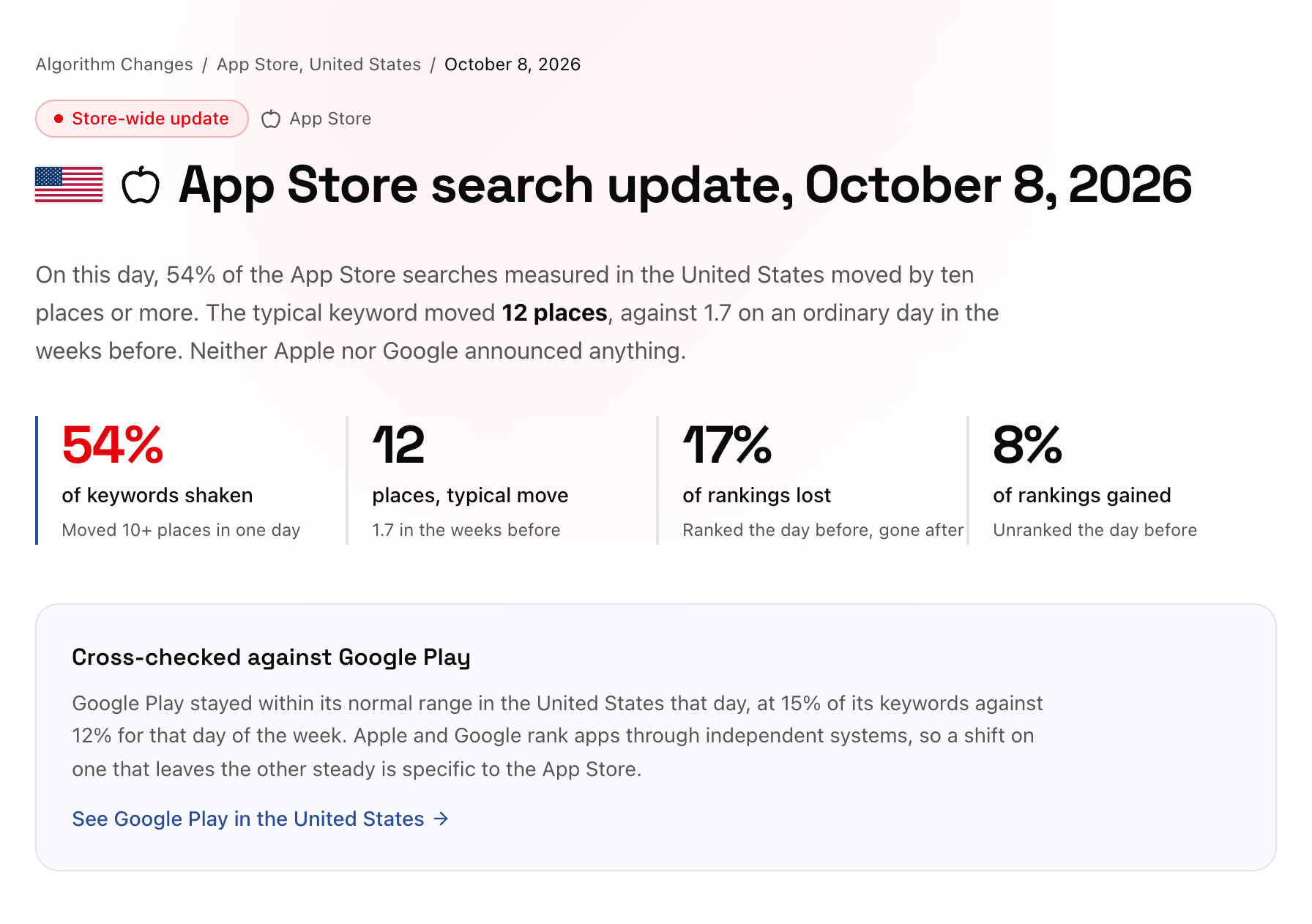
If your App Store rankings moved sharply between 8 and 10 October 2026, your listing is probably not the cause. Apple shipped an App Store algorithm update on Thursday 8 October, in several countries at once, with the United States and the United Kingdom hit hardest.
Apple did not announce it. It never does. The only way to see an update like this is to measure thousands of App Store searches every day, which is exactly what Applyra's free algorithm change detector does. It flagged this one the next day. Here is what it measured.
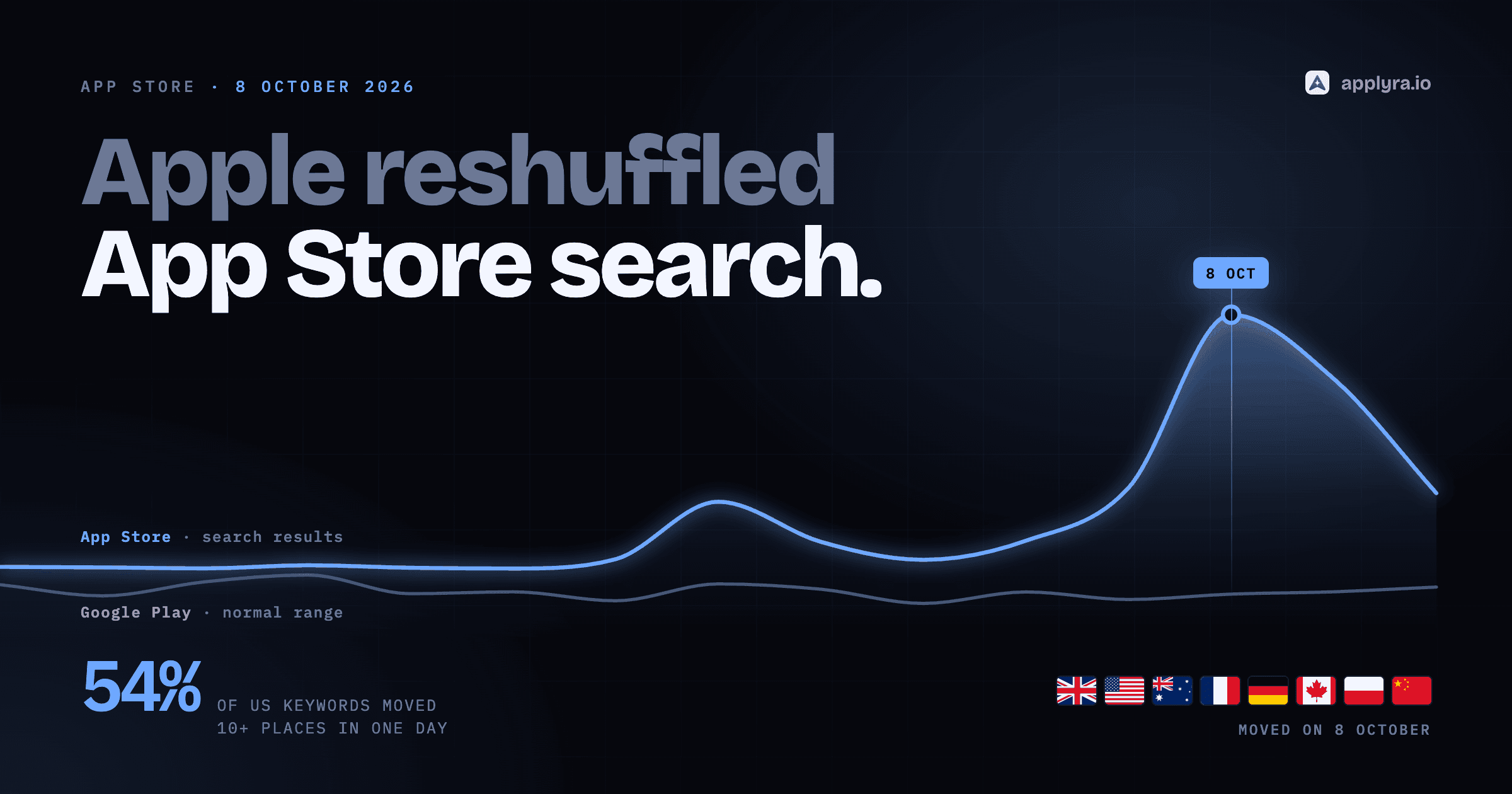
54%
of US keywords moved 10+ places in one day
3.3x
movement in the UK, against an ordinary day
8
markets moved 2x their usual level or more
1.2x
Google Play in the US, same day
What happened to App Store search on 8 October
In the United States, 54% of keywords moved 10 places or more in a single day. On an ordinary day, the typical keyword moves 1.7 places. On 8 October, it moved 12.
The movement went both ways. 17% of US rankings dropped out of the top 100 overnight, while 8% of the positions measured went to apps that did not rank for that search the day before.
The United Kingdom was hit even harder: 56% of keywords moved 10 places or more, the typical keyword moved 13 places, and overall movement reached 3.3 times an ordinary day.
Which countries were hit
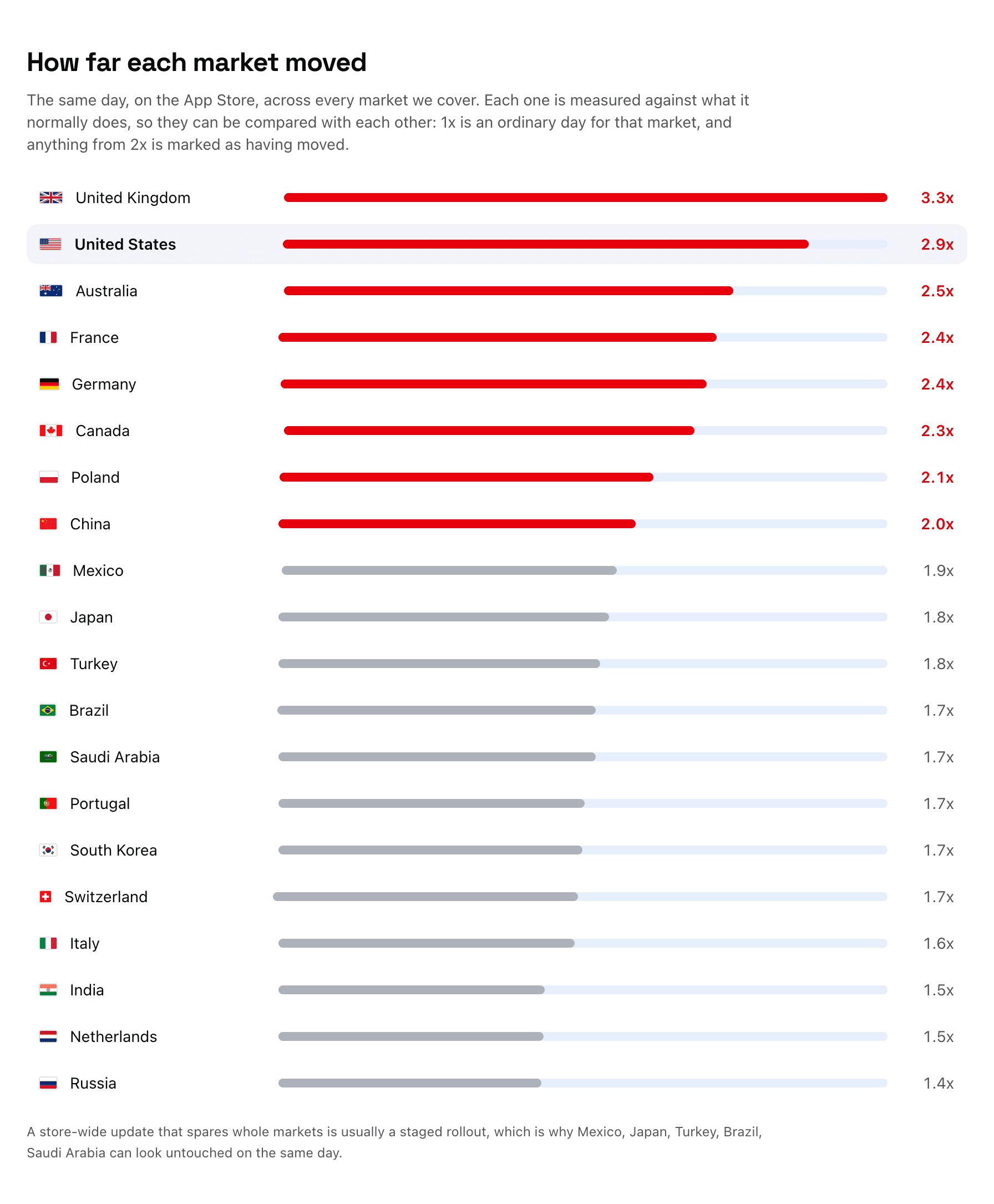
Each figure shows how much rankings moved compared with an ordinary day in that country: 1x is an ordinary day, 3x is three times the usual movement.
| Market | App Store, 8 October |
|---|---|
 United Kingdom United Kingdom | 3.3x |
 United States United States | 2.9x |
 Australia Australia | 2.5x |
 France France | 2.4x |
 Germany Germany | 2.4x |
 Canada Canada | 2.3x |
 Poland Poland | 2.1x |
 China China | 2.0x |
Three English-speaking markets lead the list: the United Kingdom, the United States and Australia. France and Germany come next, ahead of Canada, then Poland and China.
Mexico, Japan, Turkey and Brazil stayed just under the 2x line, between 1.7 and 1.9 times their usual level. When an update hits some countries harder than others, it usually means the change is reaching some markets before others.
Google Play did not follow
Applyra measures the App Store and Google Play side by side, in the same markets, every day. On 8 October, Google Play stayed within its normal range in the United States, the United Kingdom, Canada, France and Germany. In the US it ran at 1.2 times an ordinary day, against 2.9 for the App Store.
That comparison is what turns a spike into a diagnosis. One store rewrote its results, the other did not. The change came from Apple.
Did I break this, or did the store?
When your rankings fall, that is the first question to answer. The two situations look identical in a dashboard and call for opposite responses.
The fastest way to tell them apart is to compare the same app, over the same days, on a store you did not touch. Both stores down means the cause is on your side. One store down while the other holds means the store changed, and rewriting your listing will not bring the rankings back.
With Applyra, both stores are tracked side by side every day, so this check takes one look at your dashboard. The full method is in why your App Store keyword rankings dropped overnight.
It did not stop on 8 October
8 October was the peak, not the end of it.
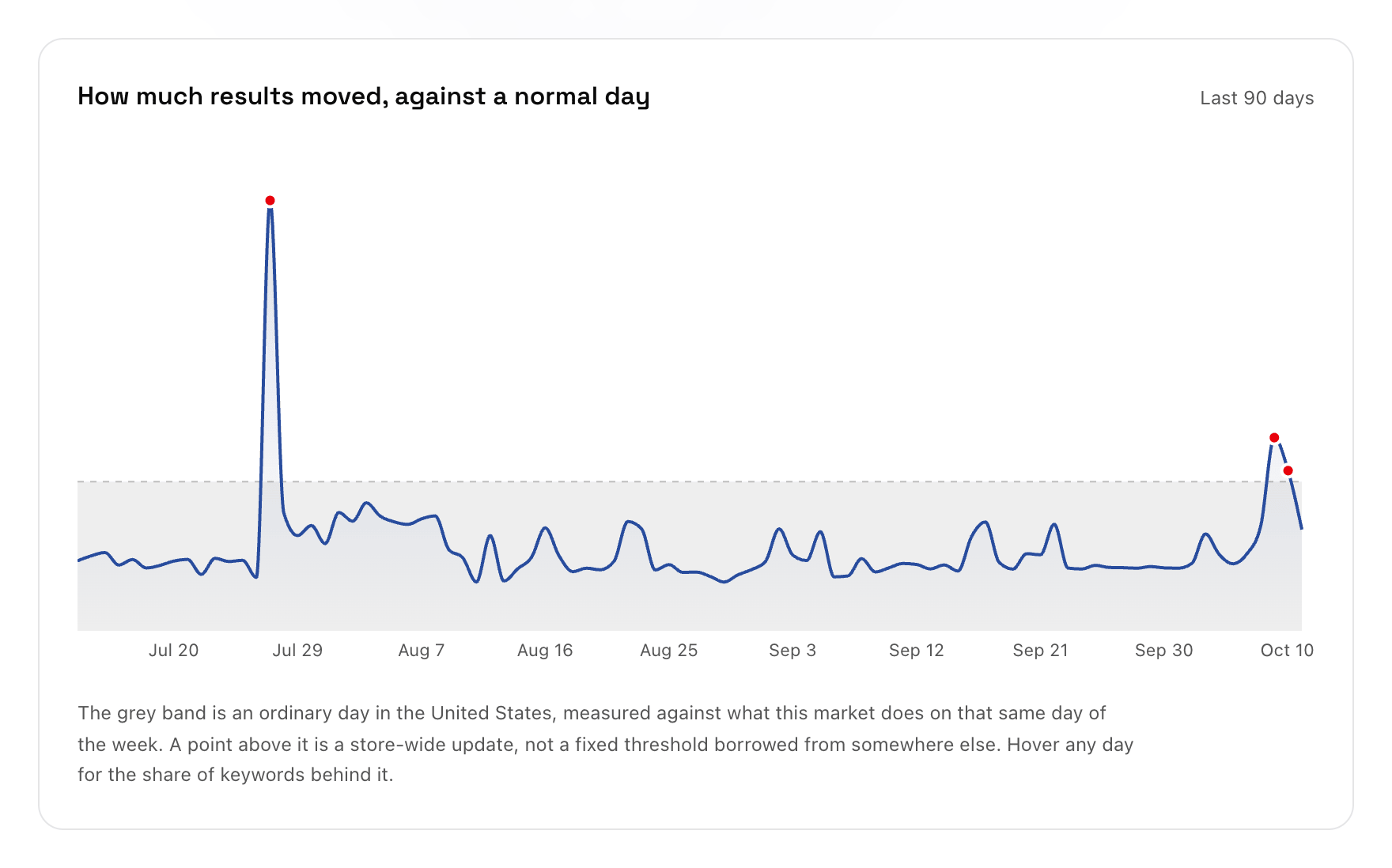
- Thursday 8 October. The peak: 54% of keywords moved 10 places or more in the United States, 56% in the United Kingdom.
- Friday 9 October. The United States was still at 45%, a second day above its normal range.
- Saturday 10 October. Still above the usual Saturday level: 28% in the United States against around 19%, 35% in the United Kingdom against around 17%.
France and Germany settled faster. By Saturday, 9% and 10% of their keywords moved, close to their usual 7% and 8%.
If your US or UK rankings kept shifting until the weekend, it was most likely the same update. The detector's United States page shows the whole sequence on one chart:
How it compares with the July 2026 update
This is the first App Store update to hit the United States and the United Kingdom since 27 July 2026. Here is how the two compare in the United States:
| United States | 27 July 2026 | 8 October 2026 |
|---|---|---|
| Movement against an ordinary day | 6.5x | 2.9x |
| Keywords that moved 10+ places | 74% | 54% |
| Typical keyword move | 28 places | 12 places |
| Rankings that left the top 100 | 33% | 17% |
October moved US search less than half as much as July, with the same pattern: no announcement, Google Play steady, and the United States and the United Kingdom among the markets hit hardest both times.
After July, the old rankings did not come back: five weeks later, the share of App Store rankings outside the top 100 was still at its new level. Treat October the same way until your own data says otherwise.
Catch the next update on your own keywords
Applyra tracks your keyword rankings on the App Store and Google Play every day, so the next update shows up as a date on your own chart. Permanent free plan, no card.
What to do if your rankings moved
Confirm the date before you change anything. If your App Store rankings moved between 8 and 10 October, this update is the first explanation to check. Applyra's algorithm change detector answers it in a few seconds, free and without an account. Here is the 8 October page for the United States, and how every market compares on it:
Wait before your next release
The most expensive response to a store-wide update is a rushed metadata change. A release makes the App Store re-read your listing at the worst possible moment, adds your own change on top of Apple's, and erases the clean before-and-after you need to understand what happened. Give the new positions two or three days first. Metadata changes take effect fast, so waiting costs you very little.
Look at what dropped out, and at what came in. The useful question is which of your keywords changed hands on 8 October, and to whom. Applyra shows it keyword by keyword, day by day, and a dated record of competitor listing changes tells you whether a rival shipped something at the same time.
Mark the date in your own history. Any before-and-after comparison that spans 8 to 10 October measures Apple's update, not your work. If you changed your subtitle on 1 October and judged it on 12 October, run that test again on dates after 10 October.
How to catch the next one
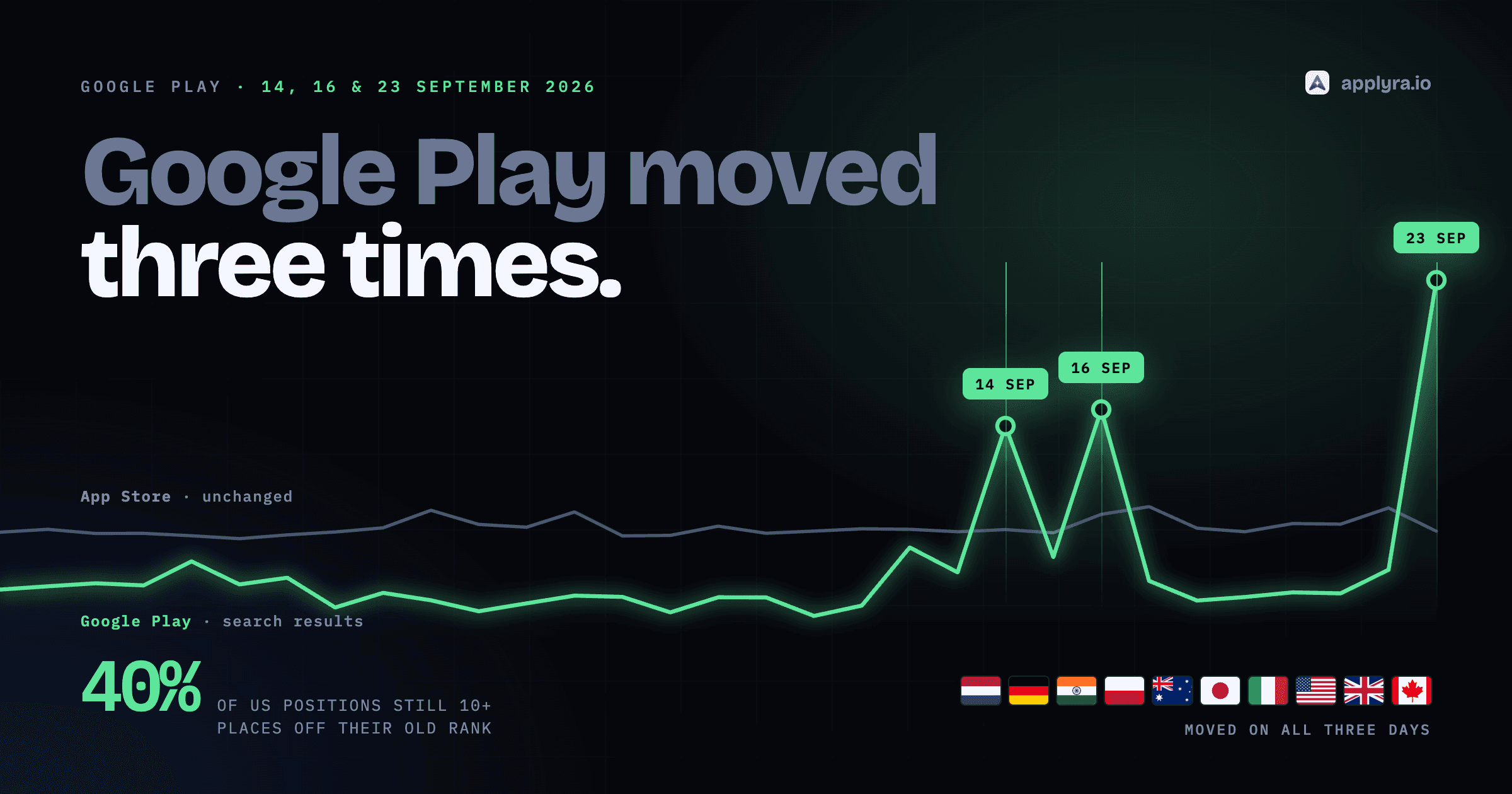
Apple has now reshuffled US App Store search twice in under three months, on 27 July and 8 October, and announced neither. Google Play went through three updates in ten days in September. Store-wide updates are now a regular part of running an app, on both stores.
Applyra's detector flagged this one the next day. With your own keywords tracked daily, you see the next one within a day, instead of spending a week rewriting a listing that was never the problem.
Applyra tracks your rankings on both stores every day, so an update shows up on your own chart, keyword by keyword. It also scores the traffic and difficulty of every keyword, so you know which moves matter. Start on the permanent free plan and move to unlimited tracking for $9.99/month when you need it. The algorithm change detector stays free for everyone, with no account required.
See the measurement behind this
App Store search volatility, by country, updated every day and free to read.
Open the algorithm change detectorFrequently asked questions
Was there an App Store algorithm update in October 2026?
Yes, on 8 October 2026, and Apple did not announce it. In the United States, 54% of keywords moved 10 places or more in a single day, overall movement reached 2.9 times an ordinary day, and the typical keyword moved 12 places against 1.7 normally. In the United Kingdom, movement reached 3.3 times its ordinary level.
Which countries were affected by the October 2026 App Store update?
Eight markets moved at least twice their ordinary level on 8 October 2026: the United Kingdom at 3.3 times, the United States at 2.9, Australia at 2.5, France and Germany at 2.4, Canada at 2.3, Poland at 2.1 and China at 2.0. Mexico, Japan, Turkey and Brazil stayed just under that line, between 1.7 and 1.9 times.
Did Google Play change at the same time as the App Store in October 2026?
No. On 8 October 2026, Google Play stayed within its normal range in the United States, the United Kingdom, Canada, France and Germany. In the United States it ran at 1.2 times an ordinary day, against 2.9 for the App Store. One store moved and the other did not, so the change came from Apple.
How big was the October 2026 App Store update compared with July 2026?
Less than half the movement in the United States. On 27 July 2026, US movement reached 6.5 times an ordinary day and 74% of keywords moved 10 places or more. On 8 October 2026 it was 2.9 times and 54%. It is the first App Store update to hit the United States and the United Kingdom since July.
What should I do if my App Store rankings dropped in October 2026?
Wait before shipping a metadata change. A new release makes the App Store re-read your listing, and you can no longer tell Apple's change from your own. Check whether your drop falls between 8 and 10 October, check whether your Google Play rankings held over the same days, give the new positions two or three days, then work from them.
Will App Store rankings recover after the October 2026 update?
Plan as if they will not. After the July 2026 update, the share of App Store rankings outside the top 100 had still not returned to its old level five weeks later. Treat the positions you see after 10 October as your new baseline, and use Applyra's daily tracking to see whether your own keywords come back.
Ready to optimize your app?
Start tracking keywords and improving your app visibility on both stores - free, no credit card required.