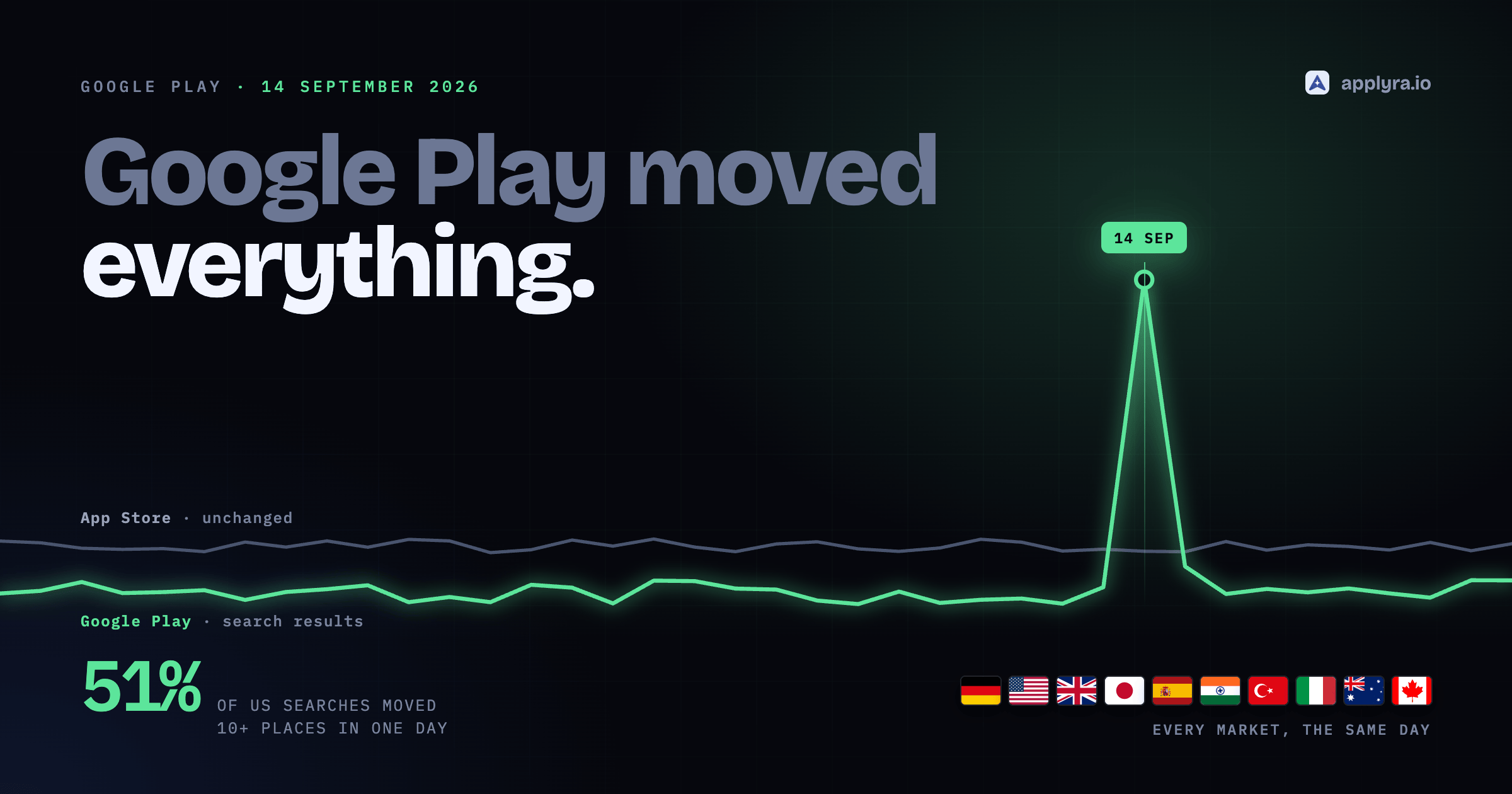
On Monday 14 September 2026, Google Play rewrote its search results. Not in one country, not in one category. Everywhere, on the same day, at a scale it hadn't reached all year.
Google said nothing. It never does. There's no changelog for Play Store search, no version number, no confirmation afterwards. The only record of an update like this is a daily measurement taken before and after it, which is exactly what Applyra's algorithm change detector exists for.
Here is what it caught.
6.7x
Germany, above its ordinary day
51%
of US keywords moved 10+ places
10
places moved by the typical US keyword
1.0x
the App Store, same day
Every major market, on the same day
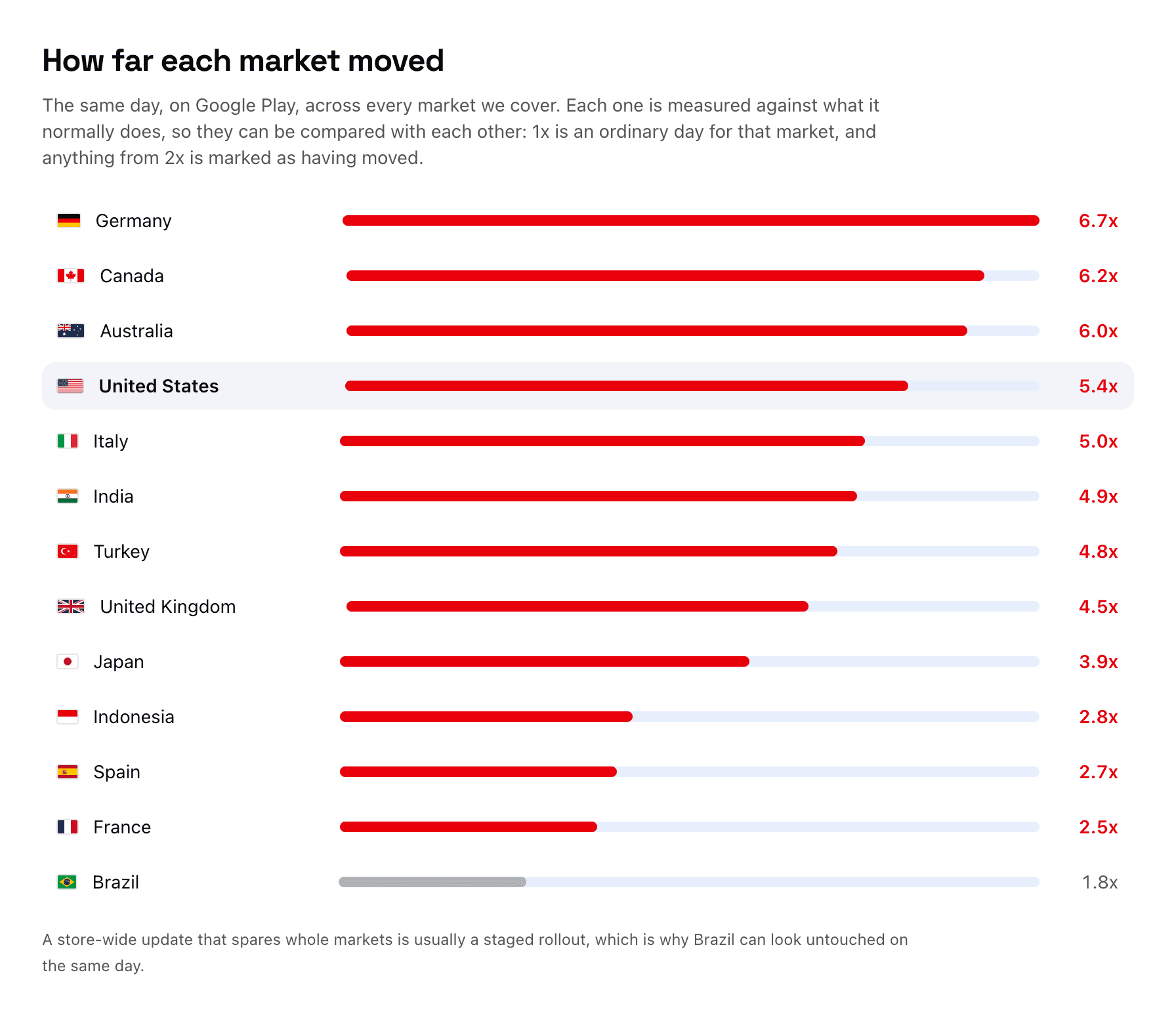
One number, the same one for both stores: how far a market ran above its own ordinary day. 1x is a normal Monday. Anything from 2x is a market that moved.
| Market | Google Play | App Store |
|---|---|---|
 Germany Germany | 6.7x | 1.0x |
 Canada Canada | 6.2x | 1.0x |
 Australia Australia | 6.0x | 1.3x |
 United States United States | 5.4x | 1.0x |
 Italy Italy | 5.0x | 1.5x |
 India India | 4.9x | 1.0x |
 Turkey Turkey | 4.8x | 0.8x |
 United Kingdom United Kingdom | 4.5x | 1.0x |
 Japan Japan | 3.9x | 1.0x |
In plain terms: in the United States, 51% of measured searches saw their apps move 10 places or more, against 4% on a normal day. The typical US keyword moved 10 positions in 24 hours, when it normally moves less than 1. In Germany the typical keyword moved 17.
Every one of these markets at once, several times above its usual level. That combination has one explanation. This was a global rollout.
The App Store never flinched
Now read the right-hand column again.
A number that moves is interesting. A number that moves while its control stays flat is proof. Applyra measures the App Store and Google Play side by side, in the same markets, on the same days, and on 14 September the App Store did exactly what it does every other day of the week. Nothing above 1.5x anywhere, while Google Play ran between 3.9x and 6.7x.
One store rewrote its results. The other did not notice. Whatever shipped that Monday, it shipped at Google.
That verdict, the cross-check included, was on the site the morning of the 15th:
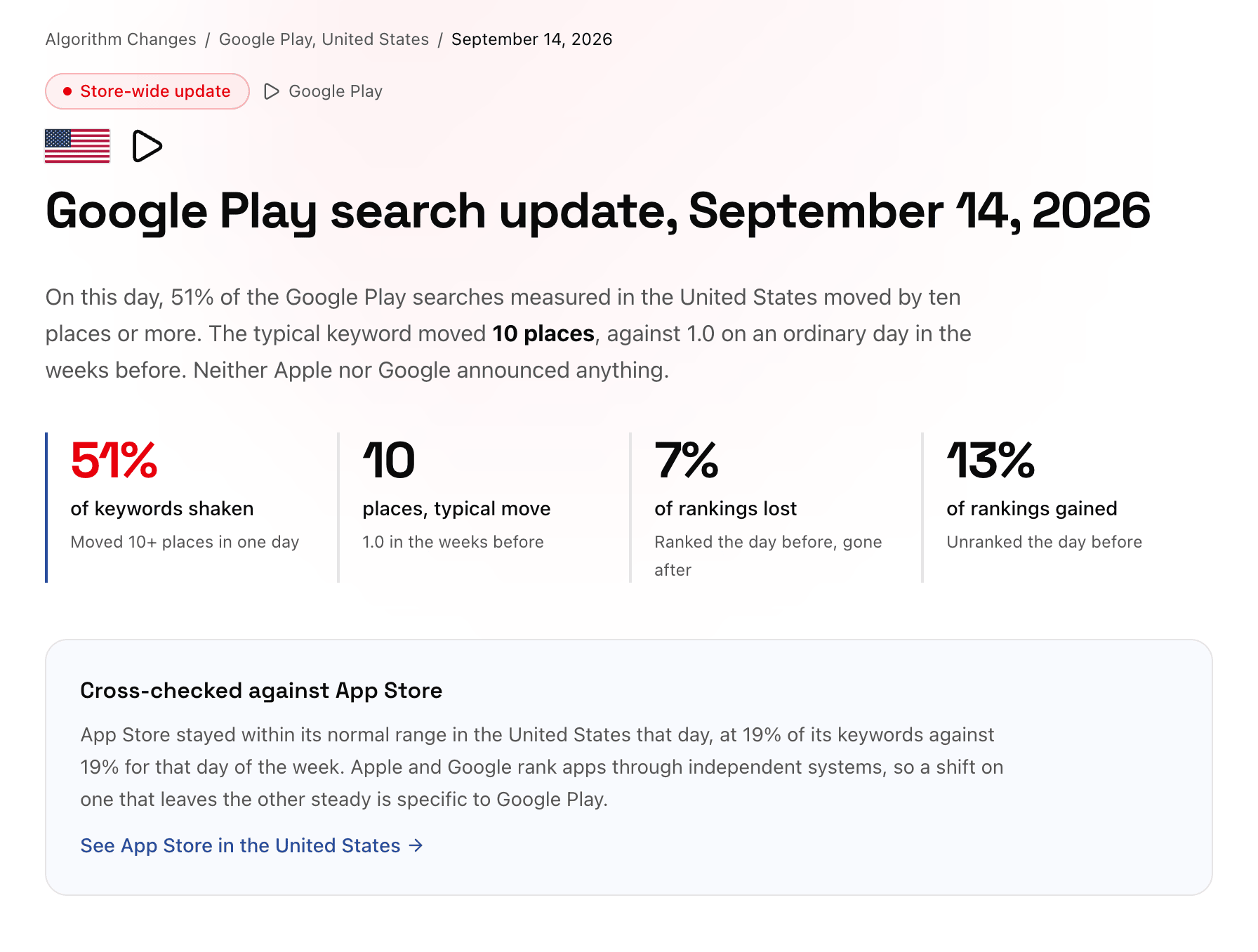
This is the diagnosis you should be running too
When your rankings fall, the first question is never how do I fix this. It is did I break this, or did the store? Those two situations look identical in a dashboard and demand opposite responses.
The fastest way to tell them apart is a control: the same app, the same days, on a store you did not touch. Both stores down means the cause is yours. One store down and the other flat means the cause is that store, and nothing you write in your listing will bring it back.
We break the full method down in why your App Store keyword rankings dropped overnight.
What Google actually changed: the middle and the tail
This is where it gets interesting for indie developers, and where a single volatility score tells you nothing useful.
We looked at every US position by where it started, and at how many kept their exact rank through the day, against the same measure on an ordinary day:
| Rank before the update | Kept its position | On an ordinary day |
|---|---|---|
| 1 to 3 | 61.7% | 85.8% |
| 4 to 10 | 18.3% | 64.3% |
| 11 to 25 | 5.9% | 40.8% |
| 26 to 50 | 2.3% | 25.8% |
| 51 to 100 | 1.2% | 16.0% |
The top 3 held up best, as they always do: established apps carry signals no single update erases. Everything below them was rewritten. In the 51 to 100 band, barely 1 position in 100 survived the day untouched, and the band as a whole gained 10 places on average.
Positions 11 to 50 went the other way. That is the band you fight for as an indie developer, the one where a good listing turns into installs, and it is the band Google reshuffled hardest.
1 in 8 positions was a newcomer
The most striking number of the day is not about who fell. It is about who arrived.
On 14 September, 1 in 8 US positions was held by an app that had not been in the top 100 for that search the day before. On an ordinary day it is closer to 1 in 90. Germany went further still, at 1 in 6.
Those apps didn't appear out of nowhere and they didn't buy their way in. They were already relevant to those searches, and this update decided they belonged on the page. More apps came in than went out, in almost every market.
That is the part worth acting on. A store-wide update is usually read as a threat. This one opened doors, and the developers who find them first are the ones who already know which searches matter to them.
It was the long tail that moved
One more cut, and it explains the rest.
We split every US search by how much it is actually searched, using Applyra's traffic score:
| Type of search | Keywords that moved |
|---|---|
| Low volume, long tail | 55.1% |
| The biggest head terms | 45.6% |
| The most competitive terms of all | 40.2% |
Single-word searches, the contested giants, moved least. The specific multi-word phrases where small apps make their living moved most.
Put that next to the rank bands and the picture is coherent: Google left the crowded head of its results comparatively alone and rebuilt the middle and the tail. Which is to say, it rebuilt the exact part of Google Play where an indie app is discovered.
The new positions held
24 hours later, roughly 9 out of 10 positions that moved were still within 2 places of their new rank.
That matters more than the size of the update. A one-day wobble reverts. This didn't. Whatever ranking you woke up to on 15 September is your position now, and the keyword strategy you built before that date was calibrated against a store that no longer works the same way.
Do not react with a release
The single most expensive response to a store-wide update is a panic metadata change. A release re-triggers indexing at the worst possible moment, adds your own variable on top of Google's, and destroys the only clean before-and-after you had. Read the new positions for two or three days first, then decide. Metadata changes land fast; there is no prize for shipping tonight.
What to do this week
Confirm the date before you touch anything. If your Google Play rankings moved between 14 and 15 September, this is why. Pick your store and country on the algorithm change detector and you have your answer in a few seconds, free and without an account. Here is the 14 September page for the United States, and how every market compares on it:
Look at your 11 to 100 keywords, not your top 3. Your strongest terms mostly survived. The movement, in both directions, is in the band below. That is where you gained and where you lost.
Re-read which keywords you can win. Every difficulty score in every ASO tool is computed from who currently ranks. Google just changed who currently ranks, everywhere. Any list of "keywords I can realistically win" built before 14 September is now stale, in every tool, whether the vendor mentions it or not. We rebuilt ours from measured data in our study of 800,000 keywords.
Mark the seam in your own history. Any before-and-after you run across mid-September is measuring Google, not your work. If you changed your short description on 8 September and judged it on 20 September, you learned nothing about your short description. Re-run that test on clean dates.
Watch what your competitors shipped around it. When a whole market moves, the apps that moved differently are the interesting ones. A dated record of competitor listing changes is what separates "the store moved" from "they did something".
Google will do this again
Twice in five weeks: 20 August, then 14 September, bigger and in more markets. Neither announced, neither confirmed, documented nowhere except in the daily measurements of the people who were already watching.
The next one is coming. The only question is whether you'll recognise it on the day, or spend a week rewriting a listing that was never the problem.
Applyra records search positions in both stores every day, scores every keyword's difficulty and traffic so you can see when the ground moves under them, and has a permanent free plan. The algorithm change detector is free and open to everyone, no account required, updated daily, in every market we cover.
The data was there on 15 September at dawn. Whether you get to use it comes down to one thing: were you tracking before the update, or after.
See the measurement behind this
Google Play search volatility, by country, updated every day and free to read.
Open the algorithm change detectorFrequently asked questions
Was there a Google Play algorithm update in September 2026?
Yes. On Monday 14 September 2026, Google Play search results changed in every major market Applyra measures. Germany ran at 6.7 times its ordinary level, Canada 6.2, Australia 6.0, the United States 5.4. In the United States that meant 51% of measured keywords moving 10 places or more, against 4% on a normal day. Google announced nothing, as it never does.
How big was the September 2026 Google Play update compared with previous ones?
It is the largest of 2026 so far. The previous one, on 20 August, showed up in 6 of the markets Applyra publishes. This one showed up in 9, and it moved them further: Germany ran at 6.7 times its ordinary level against 4.5 in August, and the median German keyword moved 17 positions in a single day against 1 on a normal day.
Which countries were affected by the 14 September Google Play update?
Nearly every market, on the same day, which is the signature of a global rollout rather than a local test. Germany was hit hardest at 6.7 times its ordinary level, followed by Canada at 6.2, Australia at 6.0, the United States at 5.4, Italy at 5.0, India at 4.9, Turkey at 4.8, the United Kingdom at 4.5 and Japan at 3.9. A few markets, Brazil among them, stayed near their normal level, which is what a staged rollout looks like.
Did the App Store change at the same time?
No, and that is what makes the diagnosis certain. Applyra measures both stores side by side every day. On 14 September the App Store sat at its ordinary level in every major market: the United States, Germany, the United Kingdom, Japan, India and Canada all read 1.0 times their normal day. One store moved, the other did not. Whatever happened, it happened at Google.
What should I do if my Google Play rankings dropped on 14 September 2026?
Do not ship a metadata change in reaction. A release re-triggers indexing and makes it impossible to separate the store's behaviour from your own. Confirm the date first, check whether your App Store rankings held over the same days, then work from the new positions. The update rewrote the middle and the tail of the results, so the keywords worth re-examining are the ones you sat at between rank 11 and 100, not your strongest terms.
Will Google Play rankings recover after the September 2026 update?
Not on their own. Roughly 9 out of 10 positions that moved on 14 September were still within 2 places of their new rank 24 hours later. A store-wide update is a new baseline, not a dip. The productive response is to re-read which keywords you can now win, because the same update pushed a large number of apps into the top 100 for terms where they had never appeared.
Ready to optimize your app?
Start tracking keywords and improving your app visibility on both stores - free, no credit card required.