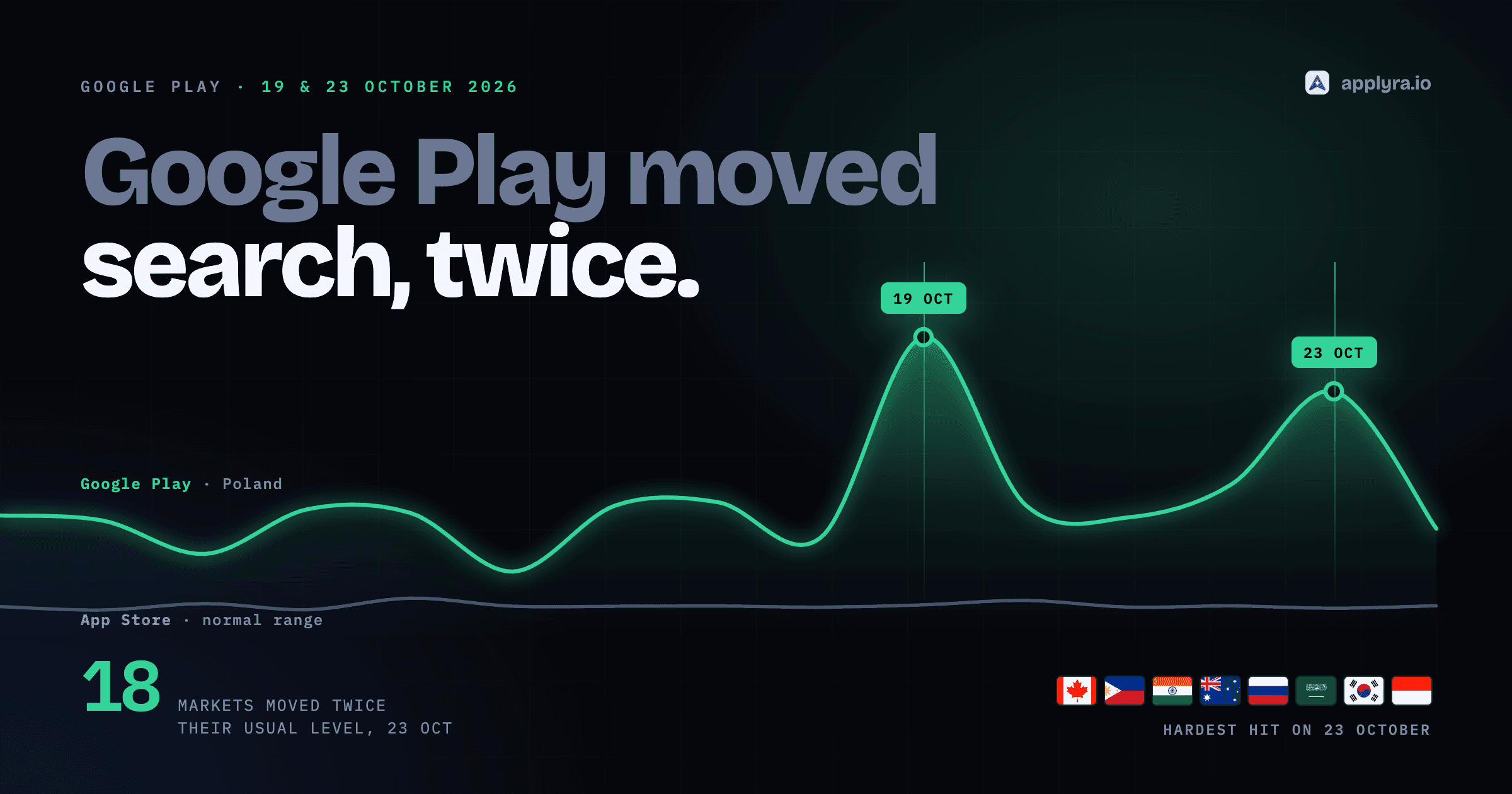
If your Google Play rankings moved on 3 or 5 November 2026, your listing is probably not the cause. The Google Play algorithm update of November 2026 hit on those two days, and it is the latest stretch of a longer run: Google Play changed its search results store-wide on 7 of the 18 days between 19 October and 5 November, most of the time in nearly every country at once.
Google hasn't said a word about it. The closest it came was a 13 October post on new AI features in Play, like app comparisons inside Ask Play search results, which says nothing about how apps are ranked. Applyra's free algorithm change detector caught every wave the day after it hit. Here is the whole run.
7
waves in 18 days, from 19 October to 5 November
17
markets moved twice their usual level on 3 November
4.8x
Saudi Arabia on 3 November, the strongest November wave
Normal
the App Store, on every one of those days
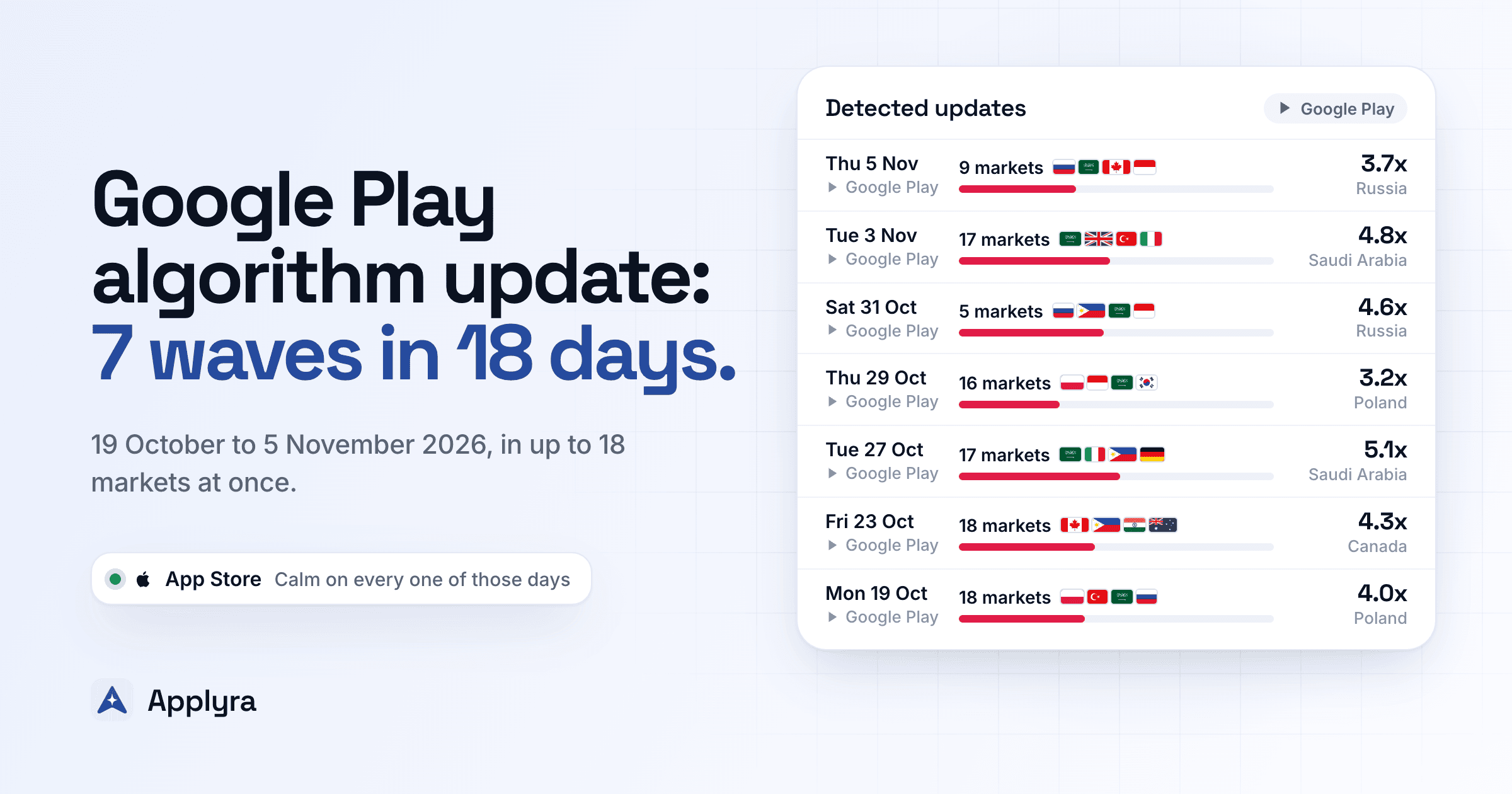
Google Play update dates since 19 October
Each market is compared with its own ordinary day: 1x is a normal day, 4x is four times the usual movement, and anything from 2x counts as a move.
| Day | Markets moved | United States | Hardest hit |
|---|---|---|---|
| Mon 19 Oct | 18 | 2.2x |  Poland, 4.0x |
| Fri 23 Oct | 18 | 2.6x |  Canada, 4.3x |
| Tue 27 Oct | 17 | 3.0x |  Saudi Arabia, 5.1x |
| Thu 29 Oct | 16 | 2.3x | Poland, 3.2x |
| Sat 31 Oct | 5 | 1.5x |  Russia, 4.6x |
| Tue 3 Nov | 17 | 2.3x | Saudi Arabia, 4.8x |
| Thu 5 Nov | 9 | 1.5x | Russia, 3.7x |
The first 2 waves are taken apart in our analysis of the October 2026 Google Play update. From 27 October, the rhythm changed: a new wave every 2 to 3 days, and the 2 biggest on back-to-back Tuesdays, both led by Saudi Arabia.
27 October: the peak of the run
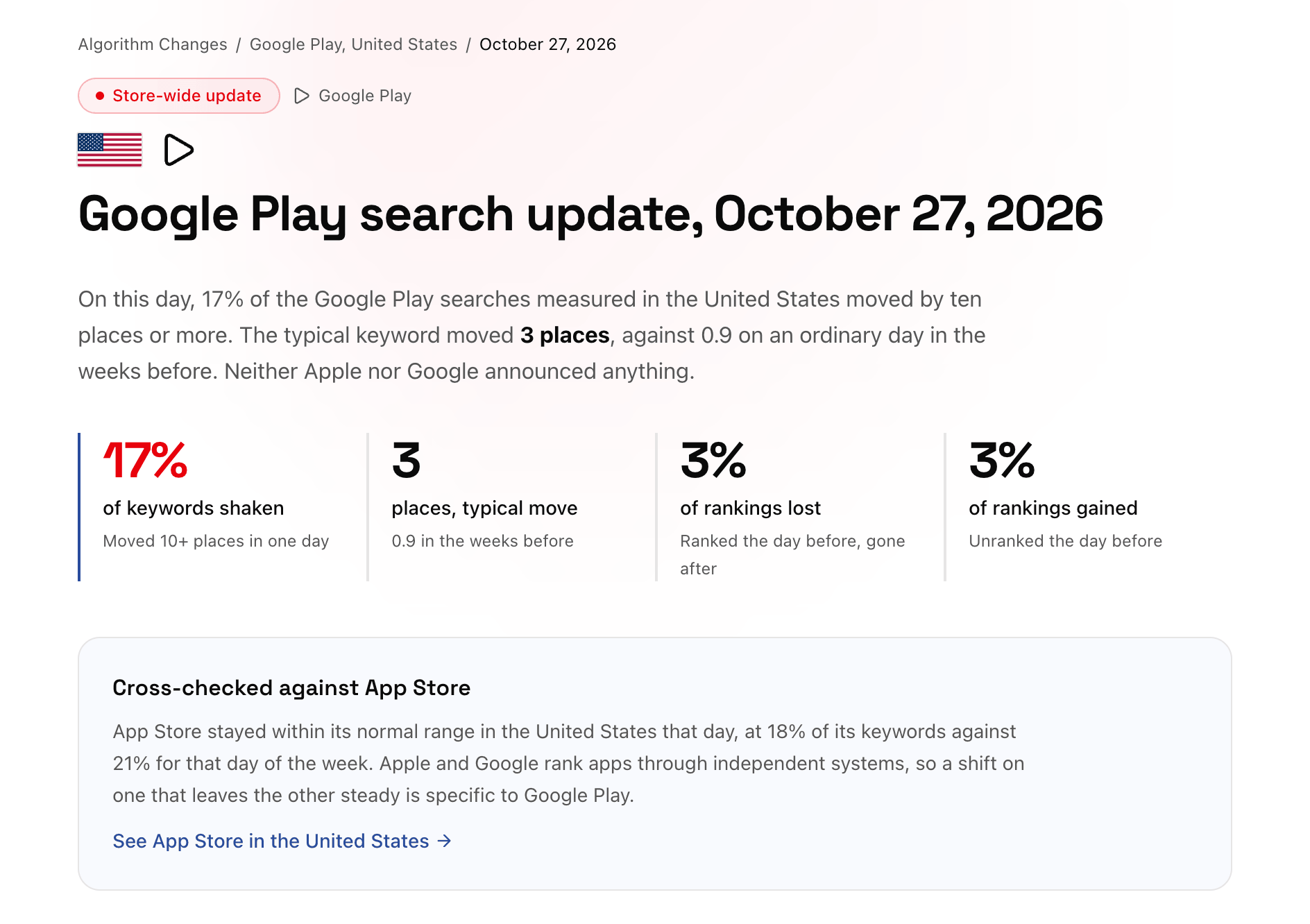
27 October was the strongest day of the run, and the one that hit the United States hardest: 17% of US searches saw their results move 10 places or more in a single day, and the typical keyword moved 3 places, against less than 1 on an ordinary day.
17 markets moved that day. Click any of these 13 for its full report on Applyra's detector:
| Market | Against an ordinary day | Searches moved 10+ places |
|---|---|---|
| Saudi Arabia | 5.1x | 19% |
 Italy | 3.9x | 19% |
 Philippines | 3.9x | 25% |
 Germany | 3.8x | 25% |
 South Korea | 3.8x | 27% |
 Indonesia | 3.6x | 20% |
| Poland | 3.5x | 20% |
 Australia | 3.5x | 12% |
 United Kingdom | 3.2x | 12% |
 United States | 3.0x | 17% |
 India | 3.0x | 15% |
 Japan | 2.9x | 23% |
 Spain | 2.7x | 17% |
The Netherlands (3.4x), Turkey (3.3x), Russia (3.2x) and France (2.7x) moved too. In South Korea, Germany and the Philippines, a quarter of searches or more moved 10 places in one day. In Germany, the typical keyword moved 4 places, against 1 on an ordinary day.
3 November: same size, one week later
One week later, Google Play hit just as hard. On Tuesday 3 November, 17 markets moved at least twice their usual level, as many as on 27 October, and Saudi Arabia led again, at 4.8x.
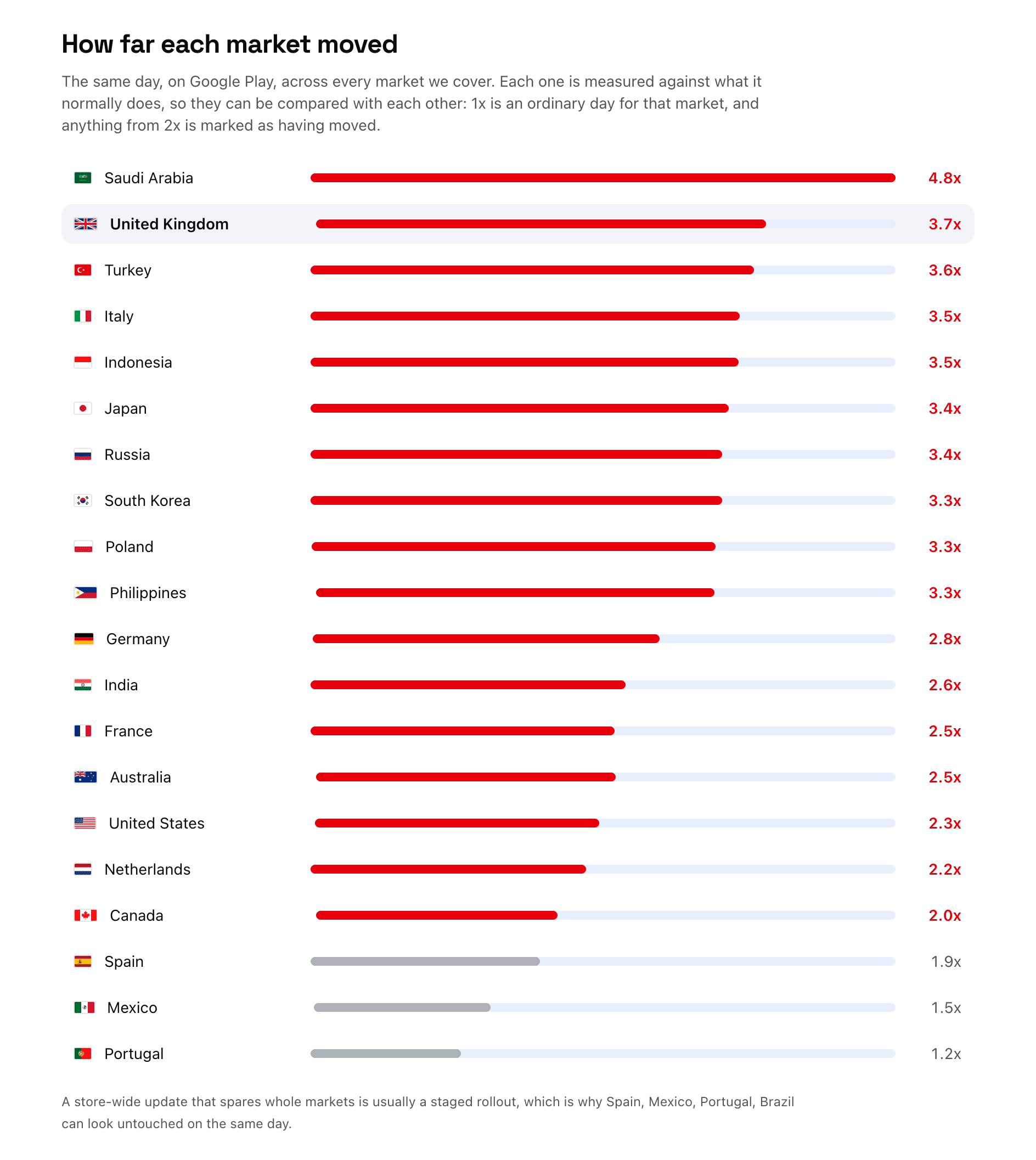
Here are 7 of them, each with its full report. Japan saw the deepest reshuffle, with 27% of its searches moving 10 places or more:
| Market | Against an ordinary day | Searches moved 10+ places |
|---|---|---|
| Saudi Arabia | 4.8x | 20% |
| United Kingdom | 3.7x | 14% |
| Italy | 3.5x | 17% |
| Indonesia | 3.5x | 20% |
| Japan | 3.4x | 27% |
| Poland | 3.3x | 15% |
| Philippines | 3.3x | 23% |
Turkey (3.6x), Russia (3.4x), South Korea (3.3x), Germany (2.8x), India (2.6x), France and Australia (2.5x), the United States (2.3x), the Netherlands (2.2x) and Canada (2.0x) moved too. Spain (1.9x), Mexico (1.5x) and Portugal (1.2x) stayed below the line, and Brazil was barely touched.
The 3 smaller waves
Around the two big Tuesdays, three smaller waves kept the store moving.
- Thursday 29 October: wide but shallow. 16 markets moved at least twice their usual level, yet none went past Poland's 3.2x. Indonesia, Saudi Arabia and South Korea followed at 3.0x.
- Saturday 31 October: narrow but sharp. Only 5 markets moved, led by Russia at 4.6x, the Philippines and Saudi Arabia at 3.4x.
- Thursday 5 November: 9 markets, led by Russia again, at 3.7x. 24% of Russian searches moved 10 places or more, and 6% of top-100 rankings vanished overnight.
Look at who keeps coming back. Saudi Arabia, Russia and Indonesia moved at least twice their usual level on all 7 days of the run, from 19 October to 5 November. Since 27 October, Mexico and Portugal never did, and Brazil barely moved. If your app sells mostly in Brazil or Mexico, the waves since 27 October may have passed you by. If it sells in Saudi Arabia, Russia or Indonesia, your market moved on all 7.
The App Store stayed calm
Applyra tracks both stores side by side, every day. On each Google Play update day, the App Store stayed within its normal range. A few examples:
| Day | Market | App Store keywords moved 10+ places | Same weekday, usually |
|---|---|---|---|
| 27 Oct | United States | 18% | 21% |
| 27 Oct | Germany | 8% | 9% |
| 3 Nov | Italy | 11% | 11% |
| 3 Nov | Indonesia | 11% | 12% |
| 5 Nov | Russia | 10% | 13% |
Google Play moved 7 times in 18 days and the App Store not once on those days, so the cause sits with Google, not in your listing. The App Store's only flag of early November was local and unrelated: Poland on 7 November, alone, at 2.4x.
7 dates to check before you blame your listing
19, 23, 27, 29 and 31 October. 3 and 5 November.
If your Google Play rankings moved on one of those days, the update is the first explanation to rule out, before your metadata, your reviews or your last release.
You don't have to remember them. In Applyra, every store update shows up as an orange band on your own ranking charts, for your store and your country, right next to your app updates and your notes. One look tells you whether the store moved or you did.
See the next wave on your own keywords
Applyra tracks your keyword rankings on Google Play and the App Store every day, and marks every store update on your own charts. Permanent free plan, no card.
What to do while your Google Play rankings keep changing
One update calls for patience. A run of them calls for a method, because waiting 2 or 3 days stops working when the next wave lands 2 or 3 days later.
Freeze your Google Play listing until it calms down. Every release you ship during the run makes Google Play re-read your listing and stacks your change on top of Google's. You won't be able to tell which of the two moved your rankings. If a release can't wait, Applyra logs it on your chart by itself, next to the update bands, so you can still tell them apart later.
Take your "before" from 18 October or earlier. Any before-and-after that spans 19 October to 5 November measures Google, not your work. If you changed your short description in late October, judge it again once things settle. Applyra's Before and after each event view does the comparison for you: your average visibility in the 7, 14 or 30 days before a change against the days after, with any store update that fell in between listed right next to it. Metadata changes take effect fast, so the retest won't take long.
Read weeks, not days. With a wave every 2 to 3 days, a single day's position is mostly noise. Compare a keyword's average over the last week with its average in the week before 19 October. A keyword that kept its level across the run is holding. One that slid on every wave is the one to work on.
Use the App Store as your control. Google Play down and the App Store flat on the same day is the store. Both down is you. The full method, with a worked example, is in why your App Store keyword rankings dropped overnight.
Wait for a calm stretch before you call a new baseline. One quiet day proved nothing in this run: 28 October, 30 October and 4 November were all calm, and each was followed by another wave. When the detector's Google Play page for your market reads calm for several days in a row, that's your new starting line. To see where you landed on a given keyword in the meantime, the free rank checker gives you your current position in any country.
10 waves in under 8 weeks
Google Play has now changed its search results store-wide 10 times since mid-September: on 14, 16 and 23 September, then on 19, 23, 27, 29 and 31 October, and on 3 and 5 November. The App Store had its own update on 8 October. None of them was announced.
Each wave of this run was smaller than the September waves: the Netherlands reached 18x on 23 September, and nothing has gone past 5.1x since. But September had 3 waves in 10 days. This run had 7 in 18. Smaller jolts, far more often, and that is much harder to read without daily data than one clean break.
With your keywords in Applyra, the next wave shows up as an orange band on your chart the day after it hits, not as a week of guessing. Applyra records your positions on Google Play and the App Store every day, keyword by keyword, and scores each keyword's traffic and difficulty so you know which drops are worth chasing. The free plan is permanent, and unlimited tracking is one $9.99/month plan. The algorithm change detector is free for everyone, no account needed.
See the measurement behind this
Google Play search volatility, by country, updated every day and free to read.
Open the algorithm change detectorFrequently asked questions
Was there a Google Play algorithm update in November 2026?
Yes, on 3 and 5 November 2026, and Google announced neither. On 3 November, 17 of the markets Applyra measures moved at least twice their ordinary level, led by Saudi Arabia at 4.8 times and the United Kingdom at 3.7, while the App Store stayed within its normal range, so the change came from Google. Both waves belong to a run that started on 19 October: 7 update days in 18 days.
Why do my Play Store rankings keep changing?
Because Google Play itself keeps changing. Between 19 October and 5 November 2026, its search results moved store-wide on 7 days out of 18: 19, 23, 27, 29 and 31 October, then 3 and 5 November. If your rankings moved on one of those days, check that date before you touch your listing, and compare with the App Store, which stayed within its normal range on every one of them. Applyra shows both stores side by side, with each of these updates marked on your ranking charts.
Which countries were affected by the November 2026 Google Play update?
On 3 November, Saudi Arabia, the United Kingdom, Turkey, Italy, Indonesia, Japan, Russia, South Korea, Poland, the Philippines, Germany, India, France, Australia, the United States, the Netherlands and Canada all moved at least twice their usual level. Saudi Arabia, Russia and Indonesia moved that much on all 7 update days since 19 October. Mexico and Portugal did not on any of the 5 days since 27 October.
Was there an App Store algorithm update in November 2026?
Not store-wide. On every Google Play update day from 27 October to 5 November 2026, the App Store stayed within its normal range: in the United States, 18% of keywords moved 10 places or more on 27 October, against 21% on an ordinary Tuesday. The only App Store update Applyra's free algorithm change detector flagged in early November was local: Poland on 7 November, alone, at 2.4 times its usual level.
Is the Google Play algorithm update over?
Too early to say. The latest wave came on 5 November 2026, and the calm days in between, such as 28 October, 30 October and 4 November, were each followed by another wave within days. Treat your Google Play rankings as provisional until Applyra's free algorithm change detector has read several calm days in a row, then use them as your new baseline.
What should I do if my Google Play rankings dropped in November 2026?
Match the date first. If the drop falls on 3 or 5 November, or on 27, 29 or 31 October, the update is the first explanation to rule out. Do not ship a metadata change while the run lasts, since a new release makes Google Play re-read your listing and stacks your change on top of Google's. Wait for a calm stretch, then compare your positions before and after in Applyra, where every store update is marked on your charts.
Ready to optimize your app?
Start tracking keywords and improving your app visibility on both stores - free, no credit card required.