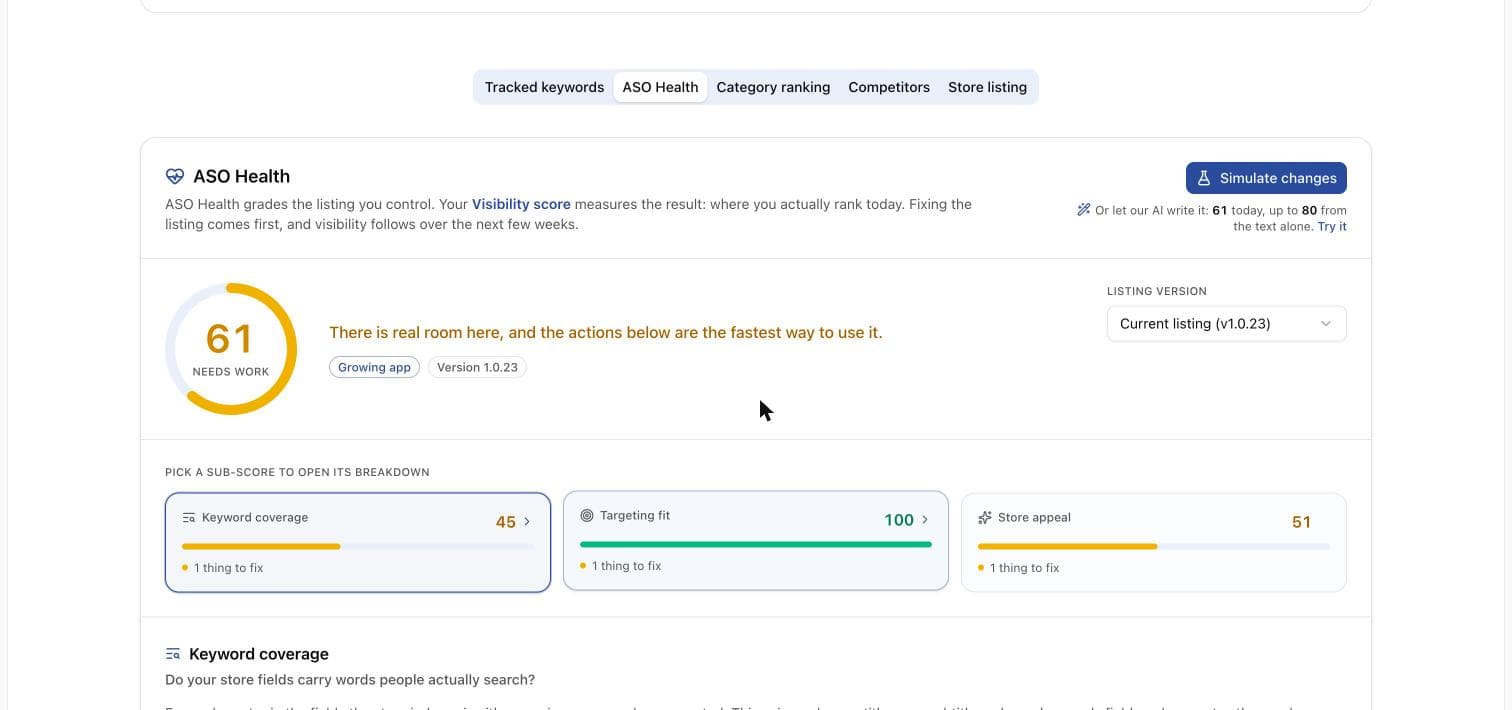
Your visibility score answers one question: where do you rank right now. It is the right question, and a poor diagnostic, because two apps with the same visibility can be there for opposite reasons. One has a sharp listing in a brutal category. The other has a sloppy listing nobody competes for.
ASO Health rates the listing itself, on three axes, each answering one question:
- Keyword coverage. Do the fields the store indexes carry words people actually search? Your title weighs the most, then your subtitle.
- Targeting fit. Are the keywords you go after winnable for an app your size? Aiming at the biggest term in the category is not a strategy when a hundred larger apps own it, and the axis gets more forgiving as your app matures.
- Store appeal. Once someone lands on your page, do they install? Rating, screenshot coverage and how recently you shipped.
Every app page now shows both scores together: a widget with the headline numbers and their direction, and a tab that opens each axis with the reason behind its score and names the one costing you the most. Thresholds are set per store, because 500 ratings on the App Store and 500 on Google Play are not the same achievement.
Read the two as a pair. High health and low visibility means keep pushing, the listing is doing its job. Low health and high visibility means the first competitor who takes ASO seriously will take those positions.