Most people looking for an AppVector alternative are not unhappy with the product. They are unhappy with the tier ladder.
AppVector is one of the rare ASO platforms actually priced for indies. That is worth saying up front, because most of this category starts at $59 and climbs from there. AppVector does not. Its entry plan lands around $9 a month, it covers both stores, and it has a free tier. If you are comparing it against AppTweak or Sensor Tower, AppVector wins on price without breaking a sweat.
So the real question is not "AppVector versus the enterprise tools." It is "AppVector versus the other tool built for someone exactly like you." I run Applyra, so I have a side. I am going to be specific about where each one actually fits instead of pretending one is strictly better.
The short version
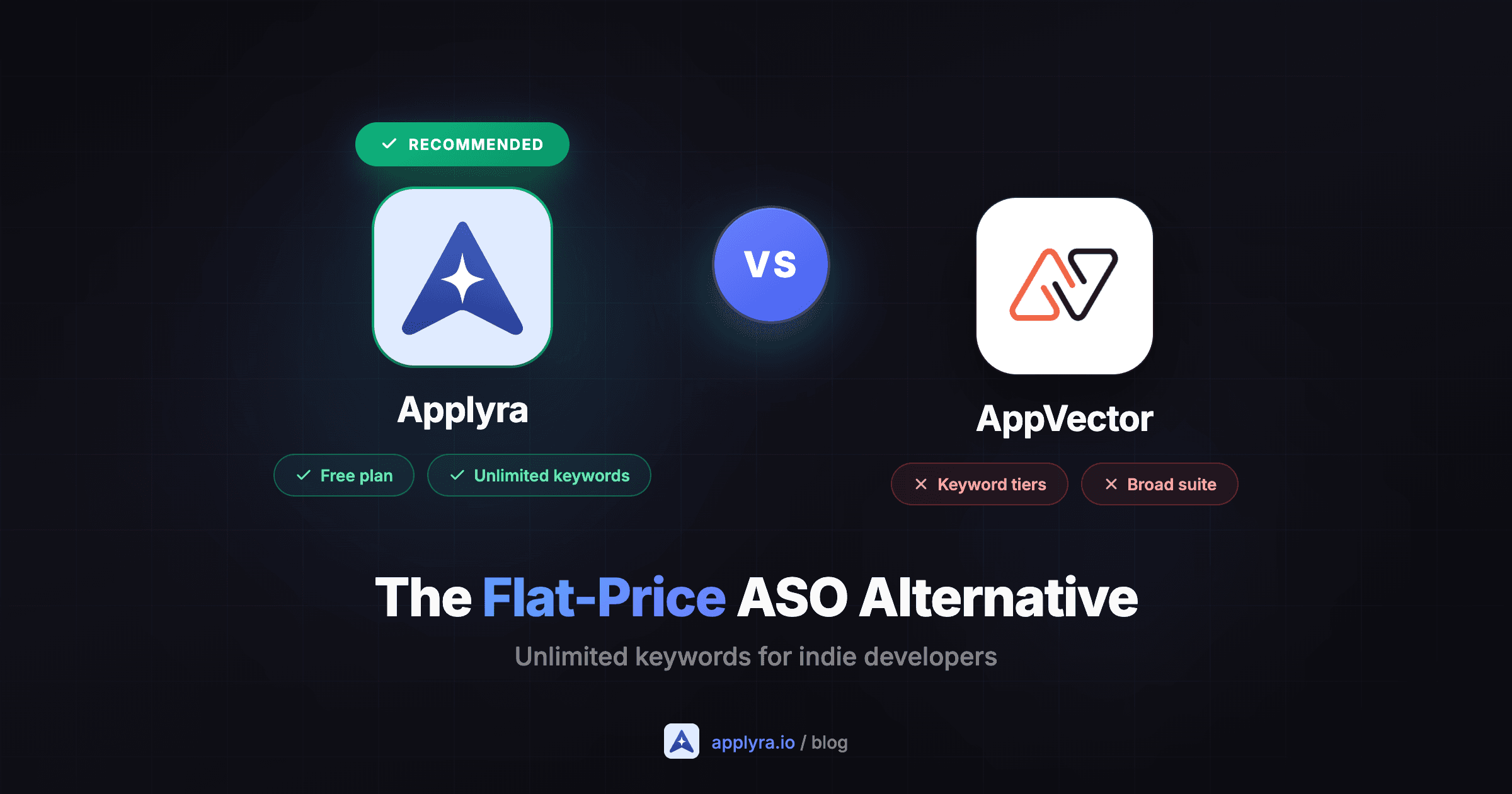
AppVector is a broad app-marketing suite: keyword tracking, Apple Search Ads management, review analysis, and market insights, with keyword limits that scale by tier. Applyra is a focused ASO tracker: one flat plan at $9.99/month for unlimited keywords on iOS and Android, AI metadata suggestions, a REST API, and a native MCP server, plus a permanent free plan. Pick AppVector if you want the wider suite. Pick Applyra if you want unlimited keywords at a flat price with nothing to manage. Start free with Applyra.
$9.99/mo
Applyra, unlimited keywords
Tiered
AppVector keyword limits
$0
Applyra permanent free plan

The short answer
| Question | Answer |
|---|---|
| Cheaper of the two | Within a dollar, around $9 against $9.99 |
| Keywords without a tier ladder | Applyra, one flat plan, no cap |
| Focused on ASO | Applyra. AppVector is a broader app-marketing suite |
| Permanent free plan | Applyra: 1 app, 5 keywords, 1 competitor, no card |
| Breadth beyond ASO | AppVector bundles wider app-marketing modules |
How I compared them
Both tools are aimed at the same person: an indie developer or small studio counting every dollar, shipping on the App Store and Google Play. So I judged them on the things that actually change your week, not the length of the feature list.
- Price shape. A flat price you never think about again beats a ladder you keep climbing as you add keywords.
- Keyword limits. How many terms you can track before the price changes.
- Focus versus breadth. A suite does more. A focused tool does less, faster, with fewer things to ignore.
- Automation and access. AI suggestions you can act on, plus a way to pull your data out (API, MCP) instead of living in one dashboard.
Price and keyword limits
This is the whole reason the comparison exists.
AppVector's Lite plan sits around $9 a month and caps how many keywords you can track. Move past that cap and you move up a tier. That is a reasonable model, and for a brand-new app tracking a handful of terms it is genuinely cheap. The friction shows up later. Real ASO means tracking your keywords, your competitors' keywords, and the long-tail variations you are testing. That list grows fast, and on a tiered tool a growing list is a growing bill.
Applyra took the other route. There is one paid plan at $9.99 a month, and it does not care how many keywords you track. Ten or ten thousand, same price. There is also a permanent free plan (1 app, 5 keywords, 1 competitor) so you can start at $0 and never hit a trial wall.
The practical difference
On a tiered tool, the question "should I track this keyword?" quietly becomes "is this keyword worth a possible upgrade?" On a flat unlimited plan, you just add it. That sounds small. Over a few months of real optimization, it changes how you work.
Where AppVector does more
I am not going to pretend Applyra covers everything AppVector does. It does not, on purpose.
AppVector is a suite. Alongside keyword tracking it gives you Apple Search Ads management, review analysis, and market insights. If you actually run paid Apple Search Ads campaigns, having the ad tooling next to your organic data is useful, and Applyra simply does not do that. Same for deep review sentiment analysis across your reviews. These are real features, and if they map to work you do every week, that breadth has value.
The trade is the usual one with suites. You navigate around modules you do not use, and the product assumes you are the kind of buyer who wants all of it. For a lot of indies, most of that surface stays closed.
Where Applyra does more
Applyra spends its focus on the part indies touch daily: figuring out what to fix, then fixing it.
It scores your listing, reads your competitors, and surfaces the keyword opportunities you are missing, with the traffic and difficulty for each. The AI suggestions are built to be acted on, not admired. And because your ASO data should not be trapped in one tab, every paid account gets a public REST API and a native MCP server, so you can pull your rankings straight into ChatGPT or Claude and ask questions in plain language. That last part is unusual at any price, let alone $9.99.
Both tools track iOS and Android. Applyra treats them as equals in one view, which matters more than it sounds: Android is over 70% of global smartphone users, and iOS-only blind spots are how indies miss half their market.
When AppVector is the better fit
Buy AppVector if you want the suite and will use it. Concretely:
- You run Apple Search Ads and want campaign management sitting next to your organic keyword data.
- You lean on review analysis and market insights as part of your routine, not just keyword tracking.
- You are fine managing keyword tiers and your list is small and stable.
None of that is a knock. It is a different buyer than the one who just wants to know which keyword to target next, on both stores, without doing tier math.
The bottom line
AppVector and Applyra are two of the few ASO tools that respect an indie budget, which already puts them in rare company. The split is about shape. AppVector is a broad suite with tiered keywords and paid-ad tooling. Applyra is a focused tracker with one flat price, unlimited keywords, AI suggestions, and an API and MCP server to get your data out.
If your work is running paid campaigns and analyzing markets, the suite earns its keep. If your work is shipping a better app and climbing the organic rankings, the flat, unlimited, focused option gets you there with less to manage.
New to this and not sure where to start? Read the complete ASO guide for indie developers, or see the whole landscape in the best ASO tools for indie developers. Watching every dollar? Here are the best free ASO tools.
Start tracking unlimited keywords free with Applyra →
Frequently asked questions
Is Applyra a good AppVector alternative?
For indie developers who mainly want keyword tracking and metadata guidance, yes. Applyra has one flat plan at $9.99 per month with unlimited keywords on the App Store and Google Play, AI suggestions, a REST API, and a permanent free plan. AppVector is a broader suite, so it fits better if you also want Apple Search Ads management and review analytics in one place.
How much does AppVector cost?
AppVector's entry Lite plan starts around $9 per month, and it offers a free tier plus a trial. Higher tiers cost more and unlock more keywords and apps. Pricing is loaded dynamically on their site, so check the current numbers before you commit.
Does AppVector or Applyra track more keywords?
Applyra tracks unlimited keywords on its single $9.99 per month plan. AppVector caps keywords on its lower tiers and unlocks more as you move up. If you track a lot of terms, a flat unlimited plan usually works out cheaper than climbing a tier ladder.
When is AppVector the better choice?
If you run Apple Search Ads and want campaign management, deeper review analysis, and market insights bundled with your keyword tracking, AppVector does more out of the box. Applyra skips paid-ad tooling on purpose to stay focused and flat-priced on organic ASO.
Do AppVector and Applyra both support iOS and Android?
Yes. Both track the Apple App Store and Google Play. Applyra treats the two stores equally in one dashboard, which matters because Android is the majority of global smartphone users.
Ready to optimize your app?
Start tracking keywords and improving your app visibility on both stores - free, no credit card required.