Most ASO advice was written for apps, then recycled for games with the nouns swapped. It fails, and everyone concludes that mobile game ASO is just harder.
It is harder. But not in the vague way people mean.
The short answer
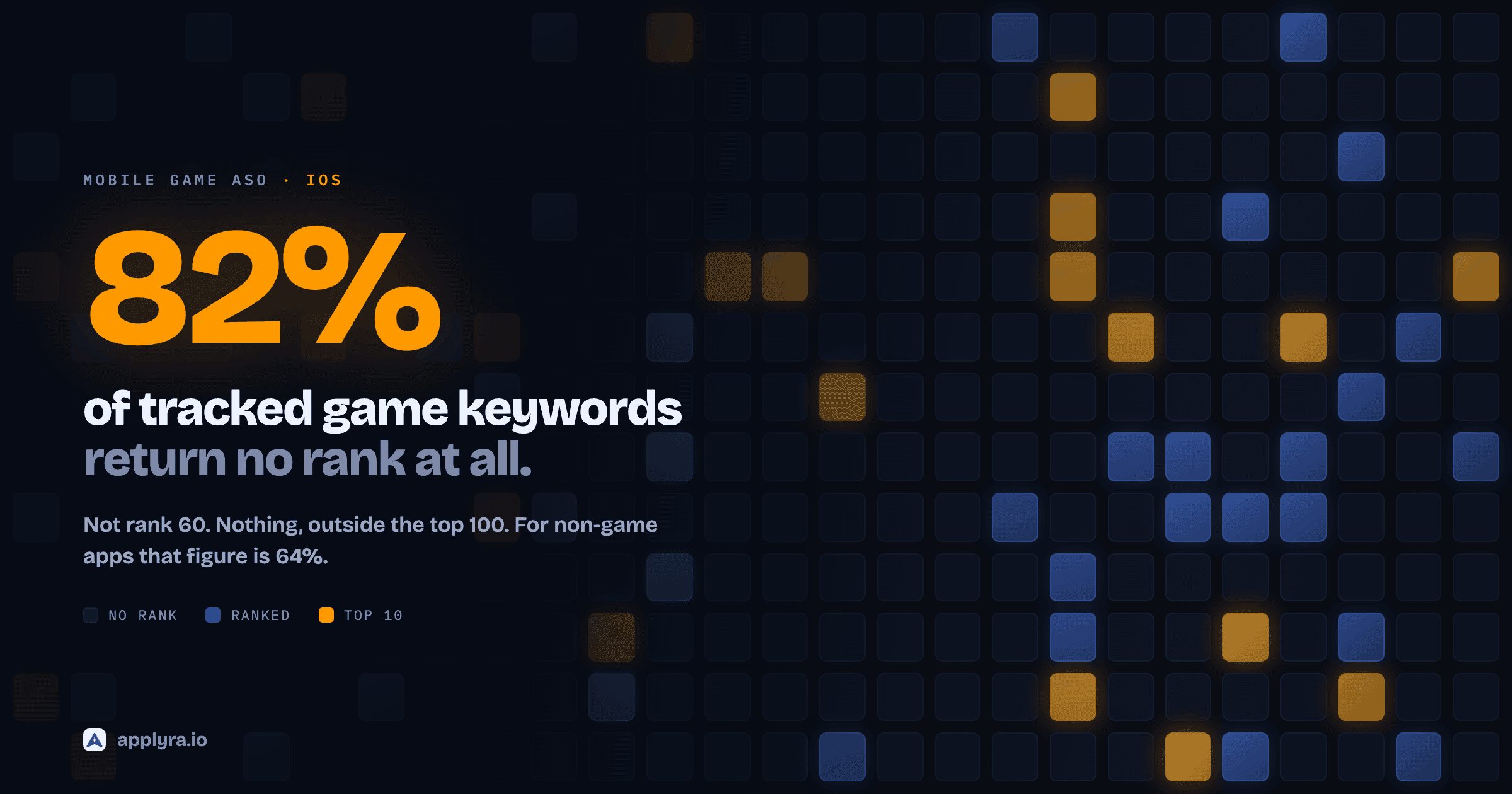
82 percent of the game keywords indie developers track return no ranking at all. Not rank 60. Nothing, outside the top 100. For non-game apps that figure is 64 percent. Games are not losing because their metadata is sloppy, they are losing because they aim at words nobody small can hold. Applyra's difficulty scores exist to catch that before you spend a title on it, and the free plan will score your list today.
Is ASO different for mobile games? The numbers
We pulled every keyword that game developers track in Applyra and compared it against the keywords everyone else tracks, split by store.
| iOS apps | iOS games | Play apps | Play games | |
|---|---|---|---|---|
| Median keyword difficulty | 29 | 42 | 24 | 28 |
| Median traffic score | 14 | 25 | 13 | 25 |
| Single-word keywords | 30% | 41% | 16% | 26% |
On iOS the median game keyword is 45 percent harder than the median app keyword.
Look at the traffic column, because it explains the difficulty column. Game developers are not accidentally picking hard keywords. They are picking big ones: median traffic score 25 against 14. They aim at terms with real volume, which are inevitably the terms everyone else aims at too.
The single-word row is the mechanism. Four in ten tracked iOS game keywords are one word. Puzzle. Idle. Racing. Merge. Those are the most contested strings in the store.
What that produces
Difficulty is a model. This is the outcome, which is not.
82%
of iOS game keyword readings show no rank
6.5%
reach the top 10, versus 17% for apps
2.6x
less likely to reach the top 10
Four out of five daily readings on a tracked iOS game keyword come back with nothing at all. And the top-10 rate is nearly identical on both stores for games, 6.5 and 6.4 percent, while the app rate differs a lot between them: 17 percent on iOS against 29 percent on Google Play. Whatever separates Apple's ranking from Google's, games hit the same ceiling on both.
The problem is entry, not movement
The obvious next question is whether game positions are simply stuck. They are not.
Look only at the days where a keyword was actually ranked on both the day before and the day after, and games move about as much as anything else: 3.5 positions a day on iOS against 3.7 for apps. On Google Play games move more, 3.5 against 2.2.
So the difficulty is not that a ranked game cannot climb. It is that a game is usually not ranked at all. Four out of five readings return nothing, and only one in fifteen reaches the top 10.
The strategic consequence
Your fight is to get into the top 100 on a term at all, and then into the top 10. Once you are in, the market is as fluid as any other. Which is why the answer is choosing winnable terms, not optimising harder against the ones where you are invisible.
See which of your game's keywords are actually winnable
Applyra scores difficulty and traffic for every keyword, tracks daily rankings on both stores, and flags the compound terms you can realistically hold. Free plan, no credit card.
What actually works for indie game ASO
If the head terms are unwinnable and you are unranked four readings out of five, the leverage sits elsewhere.
1. Compound terms, not genre nouns
The genre noun is the trap. puzzle is a word Candy Crush ranks for. merge is defended by a dozen funded studios.
What works for a small game is mechanic plus theme plus audience. Not puzzle but word puzzle for adults. Not idle but idle farming tycoon offline. Not racing but offline car racing no wifi.
These read as absurdly specific. They are also where a game with 4,000 ratings holds a top-5 position instead of rank 190. The data says it plainly: game developers target single words far more often, 41 percent against 30, and reach the top 10 at roughly a third the rate.
Two seams worth mining specifically for games:
Offline and no-wifi. A large, durable, permanently under-served intent. Players search for it constantly and most studios never put it in metadata.
Theme without genre. Dinosaurs, farming, medieval, space, cats. Players search themes, and theme terms are far less contested than mechanic terms.
2. Subgenre choice, especially on Google Play
Google Play splits games into many granular subgenres, and they are nowhere near equally crowded. In our tracked set, Puzzle holds around 5,400 apps and Music holds around 210.
Those are not equally winnable rooms. A rhythm game filed under Casual because Casual felt bigger has traded a realistic shot at subgenre visibility for a spot at the back of the largest queue in the store.
3. Spend the title, save the keyword field
The ranking weight of the fields is heavily skewed, and games have less room to waste than anyone.
A keyword entering the title is worth roughly 22 to 25 positions on iOS. The subtitle is worth about 6 to 10. The long description moves a keyword by under one position. The iOS keyword field is close to zero on entry, though leaving it costs about 12, which makes it insurance rather than growth. We measured all of it against each app's own untouched keywords in how long App Store metadata changes take to work.
For a game: the title carries your one realistic compound term, the subtitle carries the second, and the description is for the human deciding whether to install. It does not rank, and it does convert.
While you are in the fields, check you are using them: the character limits reference has the real counting rules.
4. Creative, because the impressions you already have are the ones you can win
On the handful of terms where you do rank, the fastest lever is not climbing further, it is converting more of the impressions you already get. For games that is the icon and the first two screenshots. Nobody reads a game description.
Games have an advantage here that utility apps do not: the product is visual, so the creative can carry real information about what playing feels like. A screenshot showing the actual board state beats a stylised character with a slogan over it. If you have not touched them since launch, screenshot captions are indexed as keywords now, which makes that refresh worth double.
5. Localisation, because the contest is local
The difficulty of a term is a local fact. A theme keyword that is hopeless in the US can be wide open in Brazil, Poland or Turkey, and games travel across languages far better than utility apps because the mechanic does not need translating.
Localising into five or six storefronts is a weekend of work and the single highest-leverage move available to most small games, precisely because it opens terms you can rank on at all rather than ones where you are invisible.
What to skip
Do not buy installs on a keyword. Beyond the policy risk, the data tells you what you would be buying: a temporary position in a market that reverts, on a term that was never yours.
Do not rewrite metadata weekly. A ranked game keyword moves around 3.5 positions a day on its own, so a week of data on a single term is mostly noise. Change the title every fortnight and you are permanently measuring the previous change with the current one on top of it.
Do not chase the category leaders. Track the games that appear next to you on your own keywords instead. That list is rarely the one you would write from memory, and watching what they ship is far more informative than watching the top grossing chart.
Do not treat the top 100 as a scoreboard. For a game, rank 40 on a head term and no rank at all are nearly the same outcome. Judge yourself on terms where you can plausibly reach the top 10.
What this sample is, and is not
These are keywords that developers using Applyra chose to track: 4,223 keyword pairs across 236 games on iOS, 5,398 across 319 on Google Play, with outcomes measured over 71,394 keyword-days in August 2026. It is a portrait of what indie game developers target, not a census of the stores. That is the point. The problem starts at target selection.
The honest position
None of this makes a small game compete with a funded one on puzzle. Nothing does, and any advice implying otherwise is selling something.
What it does is move the contest somewhere winnable. The head terms are a queue that does not move. The compound terms, the smaller subgenres and the storefronts nobody localised are real, reachable and mostly unattended, because the studios large enough to take them are busy defending the words you were about to waste your title on.
Pick the terms where you can get on the board at all. That is the whole game: not climbing faster, but being ranked in the first place on something a player actually types.
Frequently asked questions
Is ASO different for mobile games than for apps?
Yes, and Applyra's data makes the gap measurable. Game keywords are shorter, more generic and considerably harder. On iOS the median difficulty of a tracked game keyword is 42 against 29 for apps, and 41 percent of tracked game keywords are a single word against 30 percent for apps. The same keyword playbook produces much worse results.
Why do my game's keywords never rank?
Because most game keywords are contested head terms held by studios with enormous install bases. Across the game keywords indie developers track in Applyra, 82 percent of daily readings on iOS show no ranking at all and only 6.5 percent sit in the top 10. That is not a metadata problem, it is a target selection problem.
What actually works for indie game ASO?
Compound keywords that combine mechanic, theme and audience rather than the genre noun alone. Deliberate subgenre choice, especially on Google Play where game categories are granular and unequally crowded. Creative work on the icon and first screenshots, because ranked positions barely move for games. And localisation, since the contest for a term differs sharply by storefront.
Should I put my game genre in the title?
Usually not on its own. Single genre nouns like puzzle, racing or idle are the most contested terms in the store and the least likely to convert a search for a small game. The title is your strongest ranking field, worth roughly 22 to 25 positions on iOS, so spend it on a compound term you can hold rather than a word you will sit at rank 180 for.
Do game rankings move more than app rankings?
About the same, once you compare like with like. Counting only the days where a keyword was ranked before and after, game keywords move 3.5 positions a day on iOS against 3.7 for apps, and on Google Play games move more, 3.5 against 2.2. Game positions are not stuck. The problem is that four out of five readings return no ranking at all.
Does the Google Play game category matter for ASO?
More than for most apps, because Google Play splits games into many granular subgenres that are wildly unequal in crowding. In Applyra's tracked data Puzzle holds around 5,400 apps while Music holds around 210. Being visible in a smaller subgenre chart is a realistic goal in a way that ranking for the word puzzle is not.
Ready to optimize your app?
Start tracking keywords and improving your app visibility on both stores - free, no credit card required.