Free algorithm change detector for the App Store and Google Play
See whether the App Store or Google Play moved thousands of apps on a given day in your market, or whether the ranking drop came from your app. Free, no signup.
Video transcript
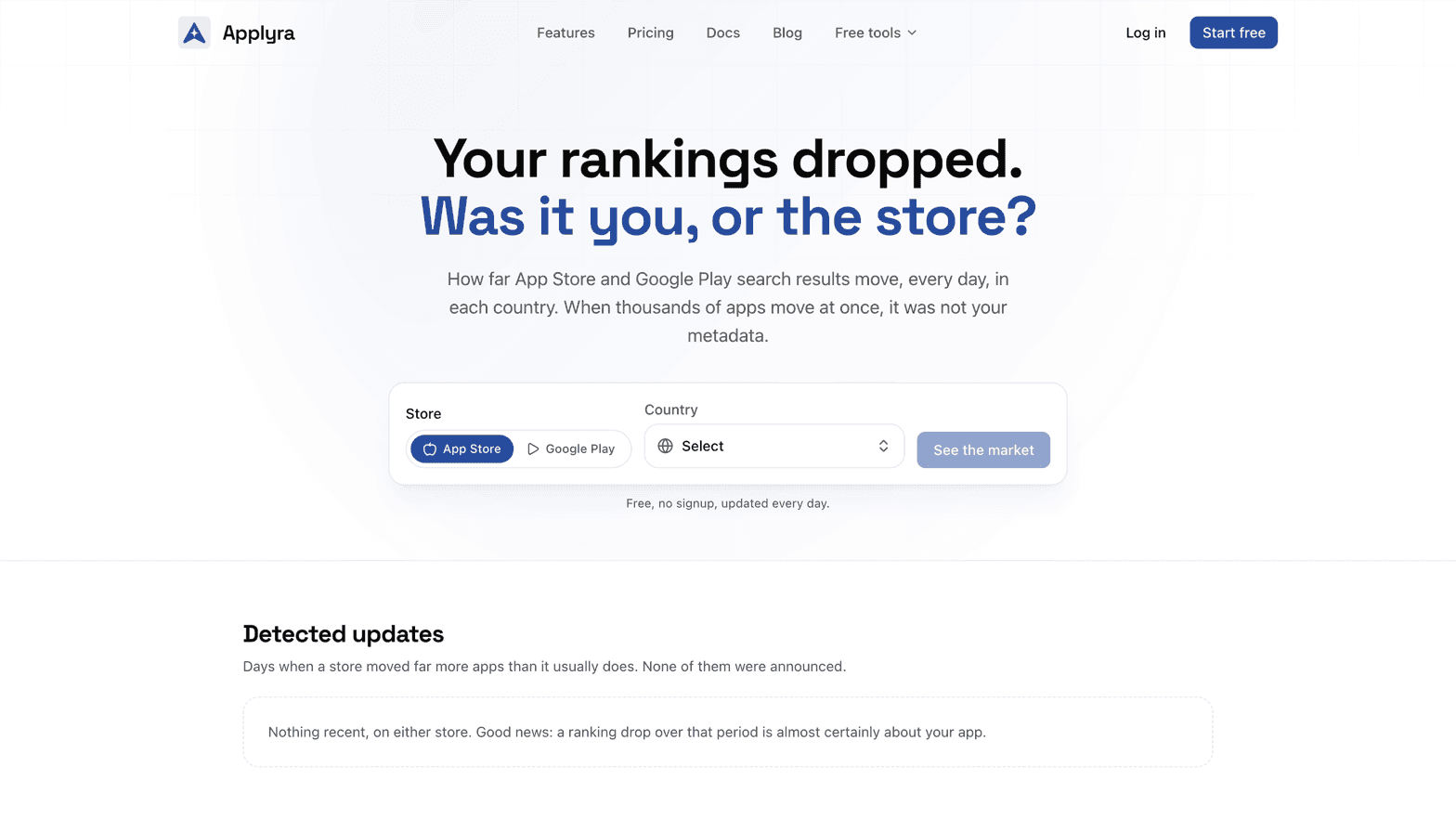
Your rankings dropped. Was it you, or the store? The algorithm change detector answers that, free, with no account. Neither store announces a ranking change. From outside, an update is thousands of apps moving on the same day. So every day, in every market, it measures the share of keywords whose results moved ten places or more. Each market is judged against its own normal, so a verdict reads the same in any country. That gives two verdicts only: Calm, or Update detected. The hub shows the last thirty days of the main markets, and every update detected on both stores. A market page charts ninety days against its normal band. Nothing there over a period means a drop came from your app. An update page details one day: how many keywords shook, how far, the rankings lost and gained, and what the other store did. When a day is red, don't touch your metadata: a rewrite in the middle of an update hides what either change did. Wait for the market to settle, then compare your positions before and after, in your rank history. The detector reads the market, not you. To see what an update did to your own keywords, track your app. The free plan does it for one app, for good.
The algorithm change detector measures how far App Store and Google Play search results move every day, in each country, and says whether a given day was ordinary or a store-wide update. It is free and needs no account. It exists to answer one question: your rankings dropped, was it you or the store?
Neither Apple nor Google announces a ranking change. From the outside an update looks like thousands of apps gaining or losing positions on the same day, which is exactly what this measures.
The number you read, and the two verdicts
The headline figure for a day and a market is the share of keywords whose results moved by ten places or more against the day before. Next to it sits the amplitude: how far the typical keyword moved, in places.
A raw percentage means nothing on its own, because an ordinary day in one country looks nothing like an ordinary day in another. So every market is judged against its own normal, which is why a verdict in Brazil and a verdict in Germany mean the same thing when you read them side by side.
That leaves two verdicts per market and per day, and only two:
| Verdict | Meaning |
|---|---|
| Calm | The day stayed inside the normal range for this market |
| Update detected | The market moved far beyond anything it normally does |
What the hub, a market page and an update page show
The hub shows the last 30 days for the featured markets, with red marking every store-wide update, and a timeline of every update detected across both stores.
A market page charts 90 days of that storefront's volatility against its own normal band, lists the updates inside that window, and links the same store in other countries. If your market shows nothing over a period, a drop in that period came from your app.
An update page is the detail of one day in one market: the share of keywords shaken, the typical move in places against a normal day, the share of rankings lost (ranked the day before, gone after) and gained (unranked the day before, ranked after), how far every other market moved the same day, and what the other store did in the same country. Where we have written up the event, the analysis is linked from the page.
What an update looks like
A recalibration. Previously ranked terms go straight out of the top 100 rather than drifting down, and the new level holds. It moves keyword difficulty too, which is the kind of break that makes a before-and-after comparison meaningless unless you know it happened. One on the App Store is written up in why App Store keyword rankings dropped.
A worldwide update. Every major market of one store moves on the same day, several times beyond its ordinary level, while the other store has a completely ordinary day. One on Google Play is written up in the Google Play algorithm update.
What to do when a day is red
Nothing to your metadata, first of all. An update is not feedback on your listing, and rewriting a subtitle in the middle of one destroys your ability to tell what the change did.
Wait for the market to settle, then compare your positions before and after the date. What moved for you specifically is in rank history, and the diagnostic walkthroughs are in my score moved and a keyword stopped ranking.
What an account adds
The detector reads the market. It does not read you. It cannot tell you which of your keywords were caught, whether you gained or lost on balance, or how long it took you to recover, because it does not know your app.
That needs a tracked app with daily positions, which is what the free plan gives you on one app and five keywords, permanently. See plans and limits, and how ranking data is collected for what "daily position" actually means. When you are ready, create an account.
Frequently asked questions
How do I know if the App Store or Google Play changed its algorithm?
Open Applyra's free algorithm change detector and pick your store and country. It measures how far search results moved that day against what that market normally does, and marks a day as a store-wide update when the whole market moved far beyond its own usual range. Neither store announces these.
My app store rankings dropped overnight. Was it me?
Check the detector for your store and country on the day it happened. If that market is marked calm, the drop came from your app or your listing. If the day is marked as a store-wide update, thousands of apps moved with you and there is nothing in your metadata to fix.
Do the App Store and Google Play update their algorithms at the same time?
No. The two stores move independently: an update can shake one store in every major market while the other has a completely ordinary day. That is why the detector reads each store separately, and why the other store is the quickest control you have.
Is the algorithm change detector free?
Yes, free with no signup. An account is what tells you which of your own keywords moved on the day of an update rather than what the market did as a whole.
Last updated on