Which websites does ChatGPT cite when it recommends apps?
The Citations tab shows the sites, pages and store listings ChatGPT and Gemini cite for your prompts: your own pages, articles, forums, social posts and stores.
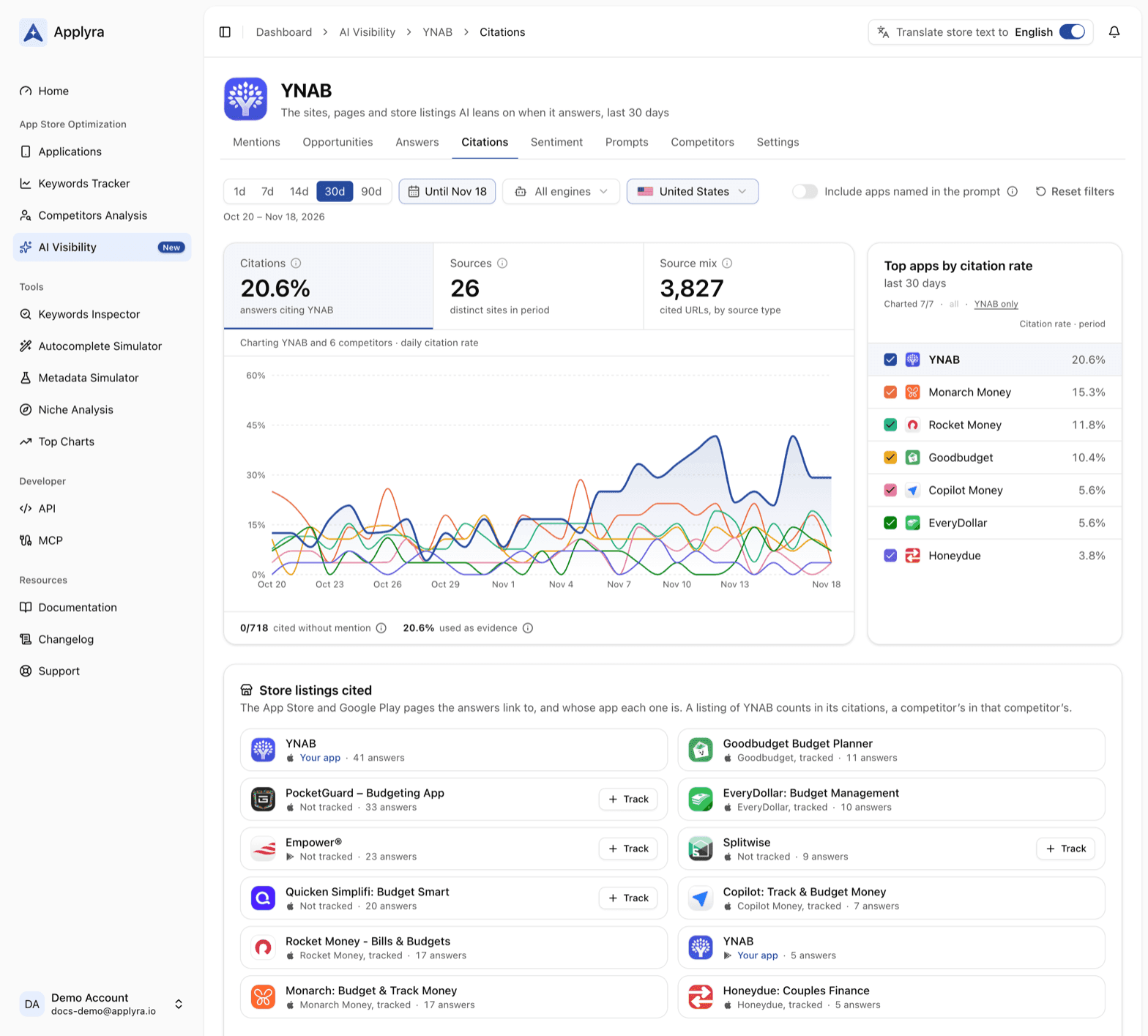
The Citations tab shows what ChatGPT and Gemini lean on when they answer your prompts: the sites, the pages and the store listings they cite. It tells you how often your own pages are among them, what kind of sources carry your category (articles and blogs, review sites, forums, social posts, store listings), and which exact domains and pages come back again and again. Those pages are where the answers are decided, so they are where your work pays.
Citation rate, sources and source mix
A citation is a page an AI answer gives as its source. A mention is your app's name in the answer itself. The two are counted apart, because an answer can cite your listing and name someone else. The tiles at the top each choose what the chart draws, like on the Mentions tab:
| Tile | What it counts | What the chart draws |
|---|---|---|
| Citations | The share of answers citing your app: one of its sites, or one of its store listings | The same citation rate for every tracked app, day by day, with Top apps by citation rate beside it |
| Sources | The distinct sites cited in the period | The share of each day's answers citing each leading site, with Leading source sites beside it |
| Source mix | Every cited page, grouped by the kind of source it is | The share of each kind, with your citation rate on each engine beside it |
The line under the chart counts cited without mention: the answers that lean on your page and still name someone else, where your page is trusted and your app not yet. Next to it, used as evidence keeps the answers that actually draw on your page. Store listings have a card of their own, below.
The kinds of source
| Kind | What it is |
|---|---|
| Your app, under its name | One of your sites, or one of your store listings |
| Competitors | A site or store listing of an app you track |
| Articles & blogs | Articles, reviews and app roundups |
| Review sites | Sites built to review and compare software |
| Forums | Threads and discussions |
| Social | Posts and videos on social platforms |
| Store listings | The store page of an app you do not track (Other store pages in the mix) |
| Websites | The home or product page of an app or company you do not track |
Your app's sites are the ones listed in its Settings tab (see change it later), so add them there if your own row looks too thin.
Store listings cited
Store listings cited lists the App Store and Google Play pages the answers link to, the most cited first (the rest are counted at the bottom), and whose app each one is: Your app, a competitor you track, or Not tracked. A listing of your app counts in your citations, a competitor's in theirs.
An app the answers keep citing that you do not track is a competitor you are not counting yet. Its Track button adds it as a competitor on both stores, with its full history: it lands on your leaderboards as if you had followed it from day one.
Which domains AI cites most for your prompts
The table at the bottom ranks the cited sites by Citing answers, with the kind of each one and which engine cites it. Click a domain and it opens on its pages: each page over time as a share of that day's answers, how often each is cited, and the prompts whose answers cite it, each one opening the answers to that prompt.
That last part is the useful one. A roundup cited for six of your prompts is worth more than ten pages cited once, and the prompts under it tell you which conversations it decides.
Why the pages AI cites decide which apps it names
When an engine searches the web before answering, it picks its apps from the pages it reads. If the roundup it cites does not include your app, the answer is unlikely to either. Being on those pages, with a description that matches what your app actually does, is the most direct lever you have: see how to get your app recommended by ChatGPT.
The Citations tab shows every page cited. Opportunities keeps the ones cited in answers that leave your app out, with the move to make on each, and the Answers tab shows the passage an engine took from each page.
The same report, domains, pages and store listings included, is available from
GET /ai-visibility/apps/{id}/citations in the API endpoints and from
get_ai_citations in the MCP tools.
Frequently asked questions
Which websites does ChatGPT cite when it recommends apps?
It depends on the question and the market, which is why Applyra's Citations tab lists the exact domains and pages ChatGPT and Gemini cite for your own prompts, grouped into articles and blogs, review sites, forums, social posts, store listings and websites.
What is the citation rate of an app?
The share of answers that cite the app's store listing or one of its sites. A citation does not require the answer to name the app, which is why Applyra also counts the answers that cite you without mentioning you.
Why does it matter to be on the pages AI cites?
When ChatGPT or Gemini searches the web before it answers, it builds its shortlist from the pages it reads. Getting your app onto a roundup or a thread it cites is how it finds your app the next time someone asks.
Can I track an app I find in the citations?
Yes. In Applyra, a store listing of an app you do not track yet carries a Track button: the app becomes a competitor on both stores, with every past answer that named it.
Last updated on